

Statement From SES
Baikonur Cosmodrome, Kazakhstan – June 19th, 2012 – ILS has informed SES (Euronext Paris and Luxembourg Stock Exchange: SESG) that the launch of the Proton launch vehicle with the SES-5 satellite has been postponed for technical reasons related to the Proton launch vehicle. The launch date will be determined at a later time.
On June 18, Khrunichev engineers at the launch site received an out of tolerance telemetry reading on a first stage subsystem during pre-flight testing.
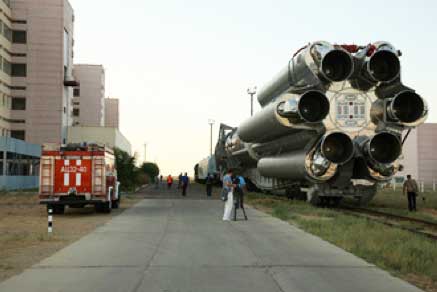
However, based on additional pre-flight testing performed on June 19, it was determined that further investigation is necessary, requiring the launch vehicle be returned to the processing hall for additional testing. The vehicle and satellite remain in a safe configuration at the launch site.
More Info From Other Sources...
According to the Khrunichev State Research and Production Space Center, the manufacturer of the Proton-M Rocket and its Briz-M Upper Stage, the Launch of SES 5 will be delayed further as technicians will need more time to fix a problem on the vehicle's first stage.
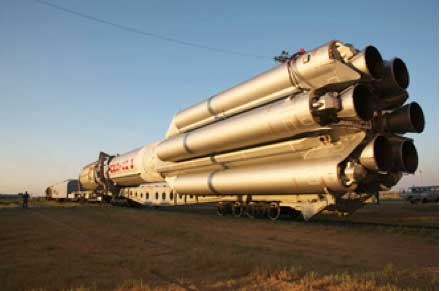
The issue is related to the Control Actuator of the first Stage of the Proton Rocket. Removing and replacing the faulty component requires the vehicle to be rolled back to the Launcher Integration Facility at the Baikonur Cosmodrome. The problem was found during the Integrated Systems Test at the launch pad when the Proton Rocket's Telemetry Stream showed 'out of tolerance values' indicating problem. After initial inspections, it was determined that the repair could not be performed in time for the prime or backup launch opportunities. Rolling the vehicle back, replacing the component and moving the Proton Launcher back to its Launch Complex will take several days. Also, testing of the new component will be performed to make sure the issue is fully resolved. Rollback is planned for Wednesday. A new launch date will be announced as repairs progress.
SES 5, also called Sirius 5, is a commercial communications Satellite that was built by Space Systems/Loral and is operated by SES World Skies. It will become part of the SES Fleet of Satellites.
The Spacecraft has liftoff mass of 6,008 Kilograms and is based on the LS-1300 Satellite Platform. The Main Payload of SES 5 are 36 Ku-Band and 28 C-Band Transponders.
Electrical Power for the Satellite Payload is generated by two deployable solar arrays and stored in on-board batteries. SES 5 will operate from an Orbital Position of 5 Degrees East in Geostationary Orbit. It will be operational for at least 15 years providing high performance and extensive coverage for direct-to-home broadcasting, broadband, point-to-point, and VSAT services in Europe and Africa.
The vehicle also includes a hosted L-Band Payload for the European Union. The navigation payload is part of the European Geostationary Navigation Overlay Service (EGNOS), which is being developed by the European Space Agency (ESA) and the European Commission (EC).
After being delivered to Geostationary Transfer Orbit by the Proton-M/Briz-M Launch Vehicle, the Satellite uses its own Propulsion System to adjust its orbit and achieve its final Geostationary Position. The vehicle is equipped with a R-4D Main Engine and four SPT-1000 Plasma Thrusters. R-4D has a dry mass of 3.76 Kilograms and is 0.55 meters in length with a nozzle diameter of 0.3 meters. It provides 489 Newtons of thrust burning Monomethylhydrazine and Mixed Oxides of Nitrogen as propellants. The engine has no burn limitations; its longest demonstration burn was 200 minutes in duration.
The Spacecraft Commissioning period will last several weeks before the satellite begins operations as part of the SES Fleet.
International Launch Services to deliver the SES 5 Spacecraft to its desired Geostationary Transfer Orbit, the Proton-M Rocket will perform a nominal ascent mission and deliver the Orbital Unit consisting of a Briz-M Upper Stage and the Payload, to a sub-orbital trajectory. The large Proton-M Rocket will launch from Pad 24 at the Baikonur Cosmodrome, Kzakhstan.
Separating after 9 Minutes and 42 Seconds, the Orbital Unit will start powered flight by igniting the Briz-M Main Engine to place itself in a Low-Earth Parking Orbit. In total, the Briz-M Upper Stage will make five Main Engine Burns separated by coast phases to increase its orbital altitude. After all burns are complete, the Satellite will be separated 9 Hours and 12 Minutes after Liftoff and start its own mission lasting for at leat 15 years.
This will be Proton’s 378th Flight since the start of the Program back in 1965. It will be the 74th ILS Proton Mission and the 5th ILS Launch of 2012. SES 5 is the 21st SES Spacecraft and the 23rd Space Systems/Loral Satellite to be orbited by ILS Proton Vehicles.