

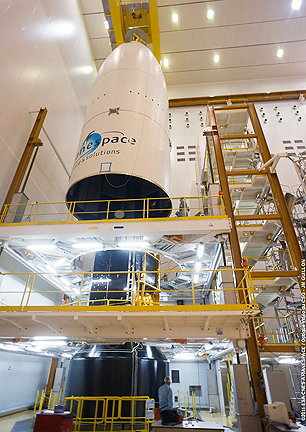
Ariane 5’s payload fairing is ready to be lowered over Arabsat-5C, which is mounted atop the SYLDA dispenser. Photo is courtesy of Arianespace.
Integration of the upper portion of Ariane 5's dual-passenger "stack" has been completed, with the Arabsat-5C satellite and SYLDA dispenser system now encapsulated inside the launcher's payload fairing in preparation for the September 9 Arianespace mission from French Guiana. This encapsulation occurred today at the Spaceport's Final Assembly Building, adjacent to where the Ariane 5 is waiting to receive Arabsat-5C and the mission's co-passenger, SES-2.
The integration process' next step will occur when SES-2 is positioned on the launcher's core section as the lower payload, allowing the "stack" to be completed with installation of the Arabsat-5C/SYLDA/fairing combination atop it. During the flight sequence, the payload fairing will be jettisoned first, followed by deployment of Arabsat-5C. The SYLDA dispenser is then released, allowing the subsequent separation of SES-2 to complete the Arianespace mission.
Ariane 5 is the launch services industry's workhorse vehicle of reference, with a demonstrated capability to perform efficient missions with dual satellite payloads. For the upcoming flight, Arabsat-5C is the mission's larger payload, with an estimated liftoff mass of 4,630 kg. SES-2 will weigh approximately 3,152 kg. at launch. The multi-mission Arabsat-5C was built for the Arab Satellite Communications Organization (Arabsat), and is to provide capacity in both the C- and Ka-bands for a range of communications services. To be operated from Arabsat's 20 degrees East orbital position, this spacecraft was manufactured in a joint effort by two European companies: EADS Astrium and Thales Alenia Space. SES-2 was produced by Orbital Sciences Corporation of the U.S., and is a hybrid C- and Ku-band spacecraft for SES WORLD SKIES that will serve North America from an orbital slot of 87 degrees West. In addition to its communications relay duties, SES-2 is carrying the Commercially Hosted InfraRed Payload (CHIRP) for the U.S. Air Force, which integrates a wide-field of view sensor in the satellite.