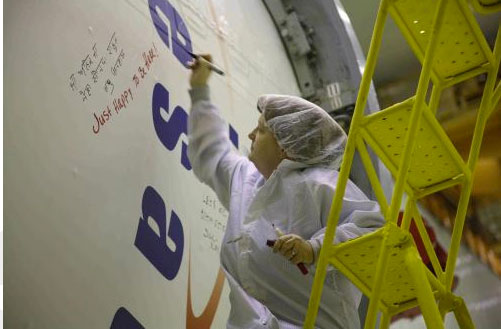
Proton-M that launched with Anik G1Powered by one RD-0213 engine, the third stage develops thrust of 583 kN (131,000 lbf), and a four-nozzle vernier engine that produces thrust of 31 kN (7,000 lbf). Guidance, navigation, and control of the Proton M during operation of the first three stages is carried out by a triple redundant closed-loop digital avionics system mounted in the Proton’s third stage.
The Briz-M (Breeze-M) upper stage is the Phase III variant, a recent upgrade which utilizes two new high-pressure tanks (80 liters) to replace six smaller tanks, along with the relocation of command instruments towards the centre – in order to mitigate shock loads when the additional propellant tank is being jettisoned.
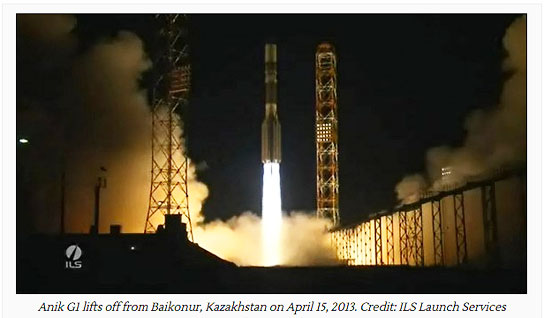
The Proton M launch vehicle, utilizing a 5-burn Breeze M mission design. The first three stages of the Proton use a standard ascent profile to place the orbital unit (Breeze M upper stage and the Anik G1 satellite) into a sub-orbital trajectory. From this point in the mission, the Breeze M performed planned mission maneuvers to advance the orbital unit first to a circular parking orbit, then to an intermediate orbit, followed by a transfer orbit, and finally to a geostationary transfer orbit.
A recent ILS mission with the Briz-M suffered a failure during the third burn with the Yamal 402 satellite. However, it performed without issue during the previous ILS mission, which successfully deployed the Satmex 8 satellite into orbit.
Separation of the Anik G1 satellite is scheduled to occur approximately 9 hours, 13 minutes after liftoff. The mission is aiming for a target orbit at separation of 9,138 km perigee, 35,786 km apogee, at an inclination of 13.4 degrees.
Anik G1Anik G1 is a commercial communications satellite built by SSL for Telesat. The multi-mission, 55 transponder satellite will be located at 107.3 degrees West longitude.
This satellite will double C- and Ku-band capacity over South America from this orbital location, provide additional DTH services in extended Ku-Band and provide military X-band coverage of the Americas and substantial portions of the Pacific Ocean.
In total, the 4,905 kg satellite sports 24 C-band transponders; 28 Ku-band transponders; and 3 X-band transponders. The planned orbital location is 107.3 degrees west longitude. The satellite, based on the SSL 1300 platform, has an anticipated service life of 15 years.
This was the second ILS Proton launch in 2013, the 79th ILS Proton launch Overall. It was also the ninth Telesat satellite launched on ILS Proton and the 26th SSL satellite launched on ILS Proton.
Topical Tags :
Regional Tags :