

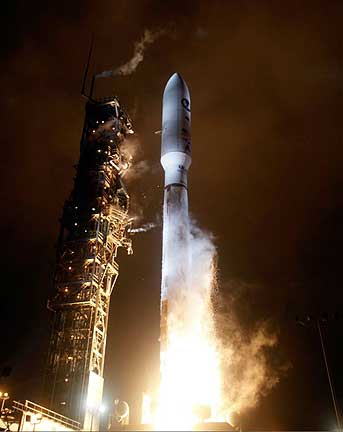
Vandenberg AFB, CA. (Sept. 21, 2010) – A United Launch Alliance Atlas V rocket blasts off from its Space Launch Complex-3 launch pad at 9:03 p.m. PDT Sept. 20. The Atlas V launched with a NRO payload in support of national defense. Photo by Pat Corkery, ULA.
This mission marked the third Atlas V from the west coast in program history. The inaugural Atlas V launch from Vandenberg occurred March 13, 2008, and the second occurred on October 18, 2009. Twenty additional Atlas V launches have taken place from SLC-41 at Cape Canaveral Air Force Station, Florida, since 2002.
"This is a proud moment for United Launch Alliance knowing this launch is providing our brave men and women fighting for our nation the space assets they need to defend America,” said Jim Sponnick, ULA vice president, Mission Operations. “I want to thank our NRO customer for entrusting ULA with the responsibility to launch this important mission. I’d also like to recognize all the team members, including our government mission partners and suppliers from around the country and around the world, who worked tirelessly to successfully launch today’s mission. Their professionalism and attention to detail have made this significant launch possible.”
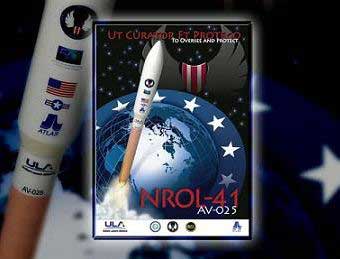
The first stage of the Atlas V, the Common Core Booster or CCB, is powered by a single RD-180 engine. The RD-180 was manufactured by NPO Energomash of Russia, and burns RP-1 propellant oxidized by liquid oxygen. The Centaur upper stage will be powered by an RL10A-4-2 engine burning liquid hydrogen with liquid oxygen again being used as an oxidizer.
This mission was launched aboard an Atlas V 501 using a 5.4-meter diameter, 77 foot long, Ruag composite payload fairing. The mission was powered by a single common core booster using the RD AMROSS RD-180 engine and a Centaur upper stage using a single Pratt & Whitney Rocketdyne RL-10A engine.
ULA's next launch, currently scheduled for October 19, is a Delta IV Heavy NRO mission in support of national defense from Space Launch Complex-37 at CCAFS, Florida. ULA program management, engineering, test and mission support functions are headquartered in Denver, Colorado. Manufacturing, assembly, and integration operations are located at Decatur, Alabama, Harlingen, Texas, and San Diego, California. Launch operations are located at Cape Canaveral Air Force Station, Florida, and Vandenberg Air Force Base, California.
Launches of NRO satellites from Vandenberg typically result in deployment into low Earth orbits, and “Molniya” orbits. A Molniya orbit, named after a series of Soviet communications satellites which used them, is a highly elliptical semi-synchronous orbit, which allows a satellite to remain over an area of the Earth for a longe period of time, at higher latitudes than could be achieved by a geostationary satellite.
The NRO’s fleet of both radar and electro-optical reconnaissance satellites are rapidly reaching the ends of their design lives; neither has been replenished since 2005, and the second most recent launches occurred 10 and seven years ago respectively. It is unlikely but not impossible that an electro-optical satellite would have a low enough density to use a 501-series Atlas, however a radar satellite, with a large dish, could.