

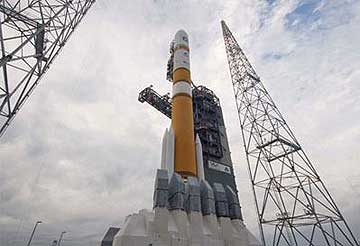
Photo credit: Pat Corkery/United Launch Alliance
The WGS-4 mission will be the fourth satellite of the WGS system and the first in the Block II series. The WGS satellites are from the space component of a new high-capacity satellite communications system providing enhanced communications capabilities to America’s troops in the field for the next decade and beyond. WGS enables more robust and flexible execution of Command and Control, Communications, Computers, Intelligence, Surveillance, and Reconnaissance (C4ISR), as well as battle management and combat support information functions.
WGS-4 will join the existing constellation of the WGS-1, 2 and 3 satellites and provide additional information broadcast capabilities. WGS-1 and WGS-2 were both launched previously on ULA Atlas V rockets on October 10, 2007 and April 3, 2009 respectfully. WGS-3 was launched on a Delta IV on December 5, 2009.
“Following the launch of WGS-3, United Launch Alliance is proud to continue our vital role in providing the latest technology for the war fighter with this contract for the fourth launch of a WGS spacecraft,” said Michael Gass, ULA President and Chief Executive Officer. "The WGS constellation was the first series of satellites to launch on both the Atlas V and Delta IV launch vehicles since the inception of ULA. This operational flexibility for our government customers was a primary reason for the creation of ULA.”
This mission will be launched by the Delta IV Medium+ (5,4) configuration using a single common booster core with a Pratt & Whitney Rocketdyne RS-68 main engine with four Alliant Techsystems GEM 60 solid rocket motors, a PWR RL10B-2 upper stage engine and a five-meter diameter upper stage and composite payload fairing.