

[SatNews] Private enterprise has accomplished a major task in space.
SpaceX’s Dragon spacecraft was berthed to the International Space Station at approximately 8:56 a.m. EST Sunday, installed onto the Earth-facing port of the Harmony module. Dragon arrived to station with over 2,300 pounds of cargo and packaging to ensure safe travel, and during the next 22 days, astronauts will unload and then load cargo, including materials to support critical science experiments.
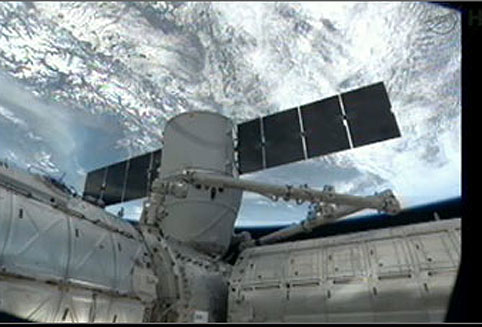
The SpaceX Dragon capsule was berthed to the Harmony module of the International Space Station at 8:56 a.m. EST. The hatch between the newly arrived spacecraft and the Harmony module of the space station is scheduled to be opened tomorrow. The capsule is scheduled to spend 22 days attached to the station.
Dragon will return to Earth with over 3,000 pounds of cargo, and has a targeted splashdown in the Pacific Ocean off the coast of Baja, California on March 25. Dragon is the only spacecraft in the world today capable of returning significant amounts of cargo to Earth.
“SpaceX is proud to execute this important work for NASA, and we’re thrilled to bring this capability back to the United States,” said Gwynne Shotwell, President of SpaceX. “Today’s launch continues SpaceX’s long-term partnership with NASA to provide reliable, safe transport of cargo to and from the station, enabling beneficial research and advancements in technology and research.”
A second contracted flight for the SpaceX Dragon spacecraft to the International Space Station will be twice as nice for researchers working with investigations on the orbiting laboratory. While other cargo ships can bring research payloads to the station, only the Dragon and the Russian Soyuz can safely get the cargo home. Scientists in the United States, Canada, France and Japan—and several high school students—are awaiting the return of their research studying a wide range of subjects, from plants to liquid crystals.
Information from NASA regarding the project...
The Dragon capsule is scheduled to launch March 1 on a Falcon 9 rocket, carrying about 1,268 pounds (575 kilograms) of supplies. On March 2, Expedition 34 commander Kevin Ford and Flight Engineer Tom Marshburn of NASA will grab the capsule with the station's robotic arm and attach it to the Harmony module, where it will stay for about three weeks. Dragon is scheduled to return to Earth on March 25, bringing home nearly double the amount of supplies it brought up -- about 2,668 pounds (1,210 kilograms). Returning investigation samples will demonstrate how life in microgravity affects the growth of plant seedlings, changes to the human body, the behavior of semiconductors and detergents, and more.
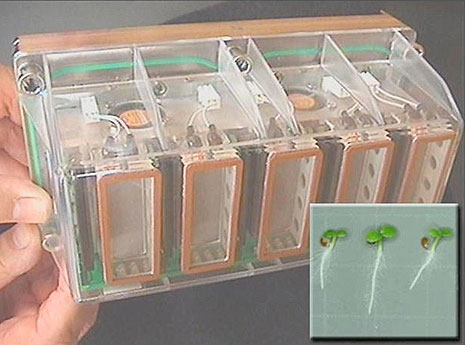
The Experiment Container with Plant Seedling Seed Cassettes (seedlings, inset lower right) is an example of the samples returning aboard the SpaceX Dragon vehicle for ground analysis. (NASA)
Several studies involve a small flowering plant called thale cress, or Arabidopsis thaliana, which is essentially the lab mouse of plant research. The Plant Signaling investigation and Biological Research in Canisters (BRIC) 17-1 both study how the plants' gene expressions change in microgravity. Scientists think plant cells living in space do not behave the same way as cells in plants on Earth, and the experiments will examine these changes on a molecular level.
In BRIC 17-1, cell cultures derived from thale cress plants are grown in Petri dishes and later examined to determine which genes are involved in certain cellular changes. A related experiment, BRIC 17-2, exposes thale cress seedlings to low oxygen levels to examine its effects on the health of their roots. The BRIC investigations will be delivered to station aboard Dragon and will come home after its three-week stay. These experiments will help biologists understand how plants respond to microgravity, which will improve efforts aimed at growing food in space -- a crucial component of long-duration missions to Mars or elsewhere in the solar system. It can also inform crop production here on Earth.
Another study making a round trip with Dragon will look at how metal mixtures solidify. Coarsening in Solid Liquid Mixtures-3 (CSLM-3) examines the growth and solidification of lead-based liquids that contain small amounts of tin. When the liquid solidifies, the tin forms small branch-like structures called dendrites. By using tiny amounts of tin, scientists can observe single dendrites at a time, which would be impossible on the ground because of gravity's effects. By understanding how temperatures and time control the growth of these dendrites, materials scientists may find new ways to produce materials from molten metals.
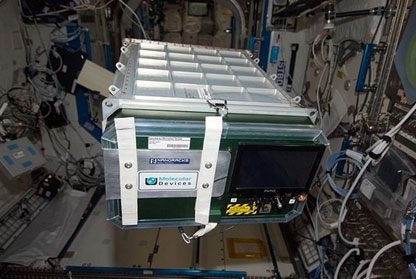
The NanoRacks Plate Reader, shown here, will enable in orbit analysis of research samples for certain studies aboard the International Space Station. (NASA)
Microgravity research can also benefit scientists trying to improve the shelf life of consumer products like toothpaste and laundry detergent. Dragon is delivering the Advanced Colloids Experiment-M-1 (ACE-M-1) investigation on behalf of Procter & Gamble, which owns several brands of personal care products. ACE-M-1 testing will take advantage of the microgravity environment of station to study how microscopic particles spread out and clump together in gels and creams. Particle additives can make a product last longer by maintaining its consistency, but they sink and clump together after a certain amount of time, which can spoil a product. It's difficult to study these dynamics on Earth because gravity gets in the way, making the space station an ideal research platform for these important industrial processes.
Along with scientists from NASA centers and private industry, plenty of students are excited for the deployment of their own experiments, facilitated by the NanoRacks system. Students from several California schools developed investigations to study bacteria, iron corrosion, battery performance and carbon dioxide levels aboard station, all of which will be delivered by Dragon.
Finally, the Wet Lab Kit will provide crew members with frequently-used tools and supplies needed to perform in-orbit experiment sample manipulation and analysis. Wetlab will increase experiments' science return while decreasing the time between investigations.
Dragon as a mode of return transport also increases the station's science return, an important capability to retrieve samples for analysis on the ground. Samples taken from the crew support human health studies in microgravity, such as the Nutrition investigation. Astronauts already provide blood and urine samples before and after flight so scientists can examine changes to their metabolism, but Dragon's cold stowage capability will allow scientists to examine samples returned in the middle of the crew's mission.
Additionally, the returning Dragon capsule will bring back several "space fish," Japanese Medaka fish (Oryzias latipes) that lived on the station since October 2012. Researchers in Japan will study changes in the bone density of the fish in the Medaka Osteoclast investigation Dragon's round-trip carrying capacity also will help scientists build upon their previous work and explore new questions. After this month's delivery, the cargo ship could have even more to bring home on its next trip -- the third time will be a charm.
Rebecca Boyle’s article International Space Station Program Science Office can be found here