

Better regenerative and life-support systems for the ISS
Node 3 and Cupola, two technological creations, will reach the International Space Station after a two-day journey, to become key elements of the completed ISS structure and support its operations. Node-3 differs significantly from the others. It is state-of-the-art, the most complex pressurised element of the ISS, offering many more capabilities than originally planned. It will accommodate sophisticated crew and life-support equipment, some relocated from the U.S. Destiny laboratory module, leaving more room there for science racks.
Node-3 will be the heart of the Station’s life support, removing carbon dioxide, generating oxygen and recycling water. It will house an additional toilet and exercise equipment for the crew of up to six.
Cupola will be used by the crew to operate the Station’s robot arm, monitor dockings of the Automated Transfer Vehicle (ATV) and other incoming craft, help out during spacewalks and make scientific observations. It also has an important function as a panoramic relaxation area: one of the most enjoyable experiences aboard the Station is looking down at Earth or up at the stars.
“Our company, and indeed the entire European space industry, are extremely proud of this new launch” declares Luigi Pasquali, Chairman and CEO of Thales Alenia Space Italy, “Providing yet further evidence of the great skills and important international role we have played in this ambitious International Space Station project. This success is the well-earned result of all the work and energy we invested in developing the living spaces with account for more than 50 percent of the pressurised elements of the orbiting home. It is a very valuable technological commitment that allows us to enjoy the status of one of the major international industrial players in the development of orbiting infrastructures and space return and transport systems”.
“For decades, Thales Alenia Space has been better known as a provider for communication, weather and remote sensing satellites as well as for our unmanned space probes. In addition to our role in space applications for serving and securing citizens, I think it's now time that we also be known as a trusted provider of ‘living and life giving space’ for human space flight”, added Reynald Seznec, Chairman and CEO of Thames Alenia Space. “Our demonstrated capabilities and skills enabled us to become a major partner in NASA's Commercial Orbital Transportation Service program — with our contribution to the Cygnus resupply vehicle — and we will play a key role in keeping the ISS operational through 2015 and, hopefully, well beyond this date”.
Node 3, dubbed ‘Tranquility’ by NASA, is the second connecting node module built by Thales Alenia Space and commissioned by the European Space Agency (ESA) as part of its Columbus Launch barter agreement with NASA. Its twin, Node 2 “Harmony”, also built in Turin, has been docked to the ISS since October 2007. This can-shaped module, about the size of a double-decker bus, will provide berthing locations for future modules or vehicles while expanding the habitable volume of the ISS by 75 cubic meters. It features standardized interfaces to accommodate research racks and living quarters. Moreover, Node 3 is equipped with the most sophisticated environmental and life support system ever flown in space, which will not only recycle water and generate oxygen but will also purify the atmosphere from toxic substances and measure their components.
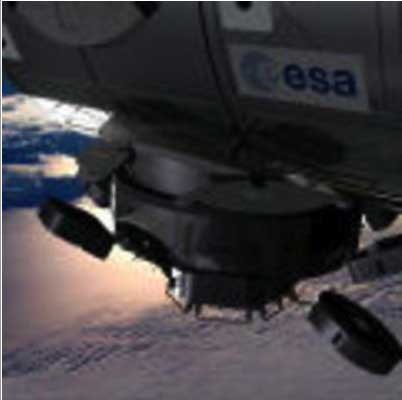
The Cupola workstation is a spectacular, technological robotized control room that will allow two astronauts to work with a direct view on the outside of the ISS. It is a truly exceptional observatory for surveying the cosmos and our planet, consisting of seven windows, six to the sides and one above, thereby providing a 360° view of space.
Each window is composed of two 25-mm thick panes with two thinner panes for damage protection from the inside and the outside. These are the largest windows ever mounted on a manned space station. Once operational, it will be used as the Station’s “flight control center”, monitoring all incoming and departing vehicles.
In order to ensure the success of the program, Thales Alenia Space has also supplied the support to NASA in carrying out the final tests and preparation for launch. Activities that are set to continue throughout all stages of the future mission, and are provided by the Altec Centre, a company set up jointly by Thales Alenia Space, the Italian Space Agency (ASI) and public bodies from the Piedmont region.