

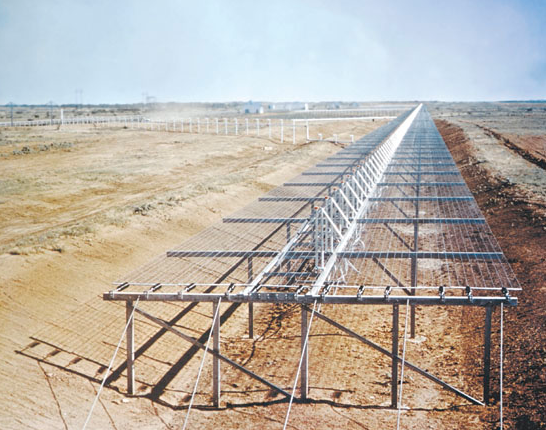
Part of the master transmitter antenna at Lake Kickapoo, Texas c.2001.
For 50 years the U.S. Air Force relied on the “Space Fence” to detect objects in orbit, be it good, bad or ugly. Now what is attributed to the automatic budget cuts know as sequestration, the shutdown came a month earlier than anticipated.
Early in August it was reported that Gen. William Shelton, commander of Air Force Space Command, had directed the AFSSS, located in Texas, "be closed and all sites vacated" effective October 1, the start of the new U.S. government fiscal year.
By discontinuing operations, the AFSSS would not be maintained in operational status; however, equipment will not be removed until a final disposition determination is made. Learn more at Raytheon’s site here.
The AFSSS sites are operated under contract and the 21st SW has notified the vendor, Five Rivers Services in Colorado Springs, Colorado, that it most likely will not exercise the next contract option beginning October 1. By de-activating the AFSSS by October 1, AFSPC would see a cost savings of approximately $14 million per year, beginning in fiscal 2014.
AFSPC officials have devised modified operating modes for the Perimeter Acquisition Radar Characterization System at Cavalier Air Force Station, North Dakota, and for the space surveillance radar at Eglin Air Force Base, Florida, which allows the discontinuation of AFSSS operations while still maintaining solid space situational awareness.
The AFSSS is a series of three transmitters and six receivers along the 33rd parallel stretching across the southern United States.The three transmitter sites are located at Jordan Lake, Alabama; Lake Kickapoo, Texas; and Gila River, Arizona. The six receivers are located at Tattnall, Georgia; Hawkinsville, Georgia; Silver Lake, Mississippi; Red River, Arkansas; Elephant Butte, New Mexico; and San Diego, California. The two receiver sites at Tattnall and Silver Lake were deactivated in April of this year.
The AFSSS, which has been operational since 1961, is just one part of AFSPC’s global Space Surveillance Network. The system is designed to transmit a “fence” of radar energy vertically into space to detect all objects intersecting that fence. The operational advantage of the AFSSS is its ability to detect objects in an un-cued fashion, rather than tracking objects based on previous information. The disadvantage is the inherent inaccuracy of the data, based on its dated design. The new operating modes at Cavalier AFS and Eglin AFB will provide more accuracy than the AFSSS and still collect un-cued observations.

The AFSSS is typically referred to as the “space fence,” which has caused confusion with the new space fence being developed for the future.
“The AFSSS is much less capable than the space fence radar planned for Kwajalein Island in the Republic of the Marshall Islands,” said General William L. Shelton, the commander of Air Force Space Command. “In fact, it’s apples and oranges in trying to compare the two systems.”
Unlike the AFSSS, the new space fence will provide very precise positional data on orbiting objects and will be the most accurate radar in the Space Surveillance Network. It will provide enhanced space surveillance capabilities to detect and track orbiting objects such as commercial and military satellites, depleted space boosters and space debris.
The new space fence will have much greater sensitivity, allowing it to detect, track and measure an object the size of a softball orbiting more than 1,200 miles in space. Because it is also an un-cued tracking system, it will provide evidence of satellite break-ups, collisions, or unexpected maneuvers of satellites.
“When combined with the new Joint Space Operations Center’s high-performance computing environment, the new fence will truly represent a quantum leap forward in space situational awareness for the nation,” Shelton said. (Courtesy of Air Force Space Command Public Affairs)