

Astronomers have used NASA's Hubble Space Telescope to photograph the iconic Horsehead Nebula in a new, infrared light to mark the 23rd anniversary of the famous observatory's launch aboard the space shuttle Discovery on April 24, 1990. This new Hubble image shows part of the sky in the constellation of Orion (The Hunter).
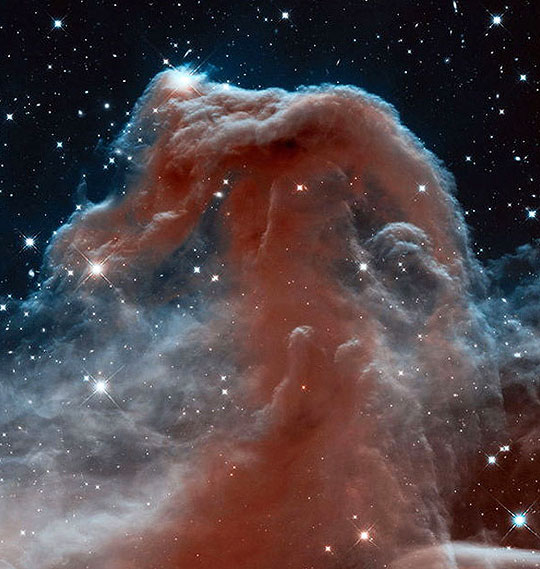
This new Hubble image, captured and released to celebrate the telescope's 23rd year in orbit, shows part of the sky in the constellation of Orion (The Hunter). Rising like a giant seahorse from turbulent waves of dust and gas is the Horsehead Nebula, otherwise known as Barnard 33. / ESA,NASA, AND THE HUBBLE HERITAGE TEAM (AURA/STSCI)
Astronomers have used NASA's Hubble Space Telescope to photograph the iconic Horsehead Nebula in a new, infrared light to mark the 23rd anniversary of the famous observatory's launch aboard the space shuttle Discovery on April 24, 1990.
"The result is a rather ethereal and fragile-looking structure, made of delicate folds of gas—very different to the nebula's appearance in visible light," mission officials wrote in an image description today (April 19). The new observations allowed astronomers to create a dazzling video of the Horsehead Nebula based on Hubble's photos.
The Horsehead Nebula, also known as Barnard 33, is located about 1,500 light-years from Earth in the constellation Orion (The Hunter). The cloud also contains other well-known objects such as the Great Orion Nebula (M42), the Flame Nebula, and Barnard's Loop. The Horsehead is a huge interstellar cloud of gas and dust, like other nebulae, and the light from a nearby star gives it a beautiful glow. It is one of the nearest and most easily photographed regions in which massive stars are being formed.
In the Hubble image, the backlit wisps along the Horsehead's upper ridge are being illuminated by Sigma Orionis, a young five-star system just out of view. Along the nebula's top ridge, two fledgling stars peek out from their now-exposed nurseries.
The object is a popular observing target, and Hubble has taken numerous Horsehead photos over the years—including in 2001, to celebrate the telescope's 11-year anniversary.
Scientists know a harsh ultraviolet glare from one of these bright stars is slowly evaporating the nebula. Gas clouds surrounding the Horsehead already have dissipated, but the tip of the jutting pillar contains a slightly higher density of hydrogen and helium, laced with dust. This casts a shadow that protects material behind it from being stripped away by intense stellar radiation evaporating the hydrogen cloud, and a pillar structure forms.
The Hubble Space Telescope is perhaps best known for its photos in visible light. But the telescope's Wide Field Camera 3, which was installed by spacewalking astronauts in 2009, also takes crisp images in infrared wavelengths, researchers said.
Hubble, a collaboration between NASA and the European Space Agency, has made more than 1 million science observations since its 1990 launch, and it's still going strong. NASA announced last month that it had extended the telescope's science operations through April 2016. The Hubble Space Telescope is a project of international cooperation between NASA and the European Space Agency. NASA's Goddard Space Flight Center in Greenbelt, Maryland, manages the telescope. The Space Telescope Science Institute (STScI) in Baltimore, Maryland, conducts Hubble science operations. STScI is operated by the Association of Universities for Research in Astronomy Inc., in Washington.
NASA's highly anticipated successor to Hubble, the $8.8 billion James Webb Space Telescope, is slated to blast off in 2018. JWST is optimized to view in infrared light.