

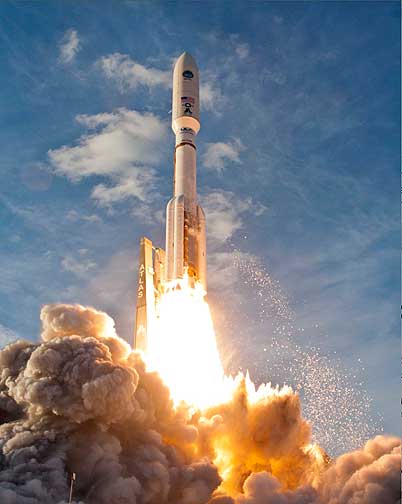
Cape Canaveral Air Force Station, Fla. (Feb. 24, 2012) – A United Launch Alliance Atlas V rocket blasts off from Space Launch Complex-41 at 5:15 p.m. EST with the U.S. Navy’s Mobile User Objective System-1 (MUOS-1) satellite. This is ULA’s 2nd launch of an aggressive 11 mission schedule for the year and is the 200th flight of the Centaur upper stage. At nearly 15,000 pounds, MUOS-1 marks the heaviest satellite launched to date by an Atlas launch vehicle. MUOS-1, built by Lockheed Martin, is a next-generation narrowband tactical satellite communications system designed to significantly improve ground communications for U.S. forces on the move. Photo by Pat Corkery, United Launch Alliance
Cape Canaveral Air Force Station, Florida. (February 24, 2012) - The launch of an Atlas V carrying the United States Navy's Mobile User Objective System-1 (MUOS-1) payload from Space Launch Complex-41 at Cape Canaveral Air Force Station, Florida, occurred following two weather scrubs late last week. This was ULA’s 2nd launch of an aggressive 11 mission schedule for the year and at nearly 15,000 pounds, MUOS-1 marks the heaviest satellite launched to date by an Atlas launch vehicle.
"ULA is honored to serve with our mission partners in the preparation and launch of this important mission for the U.S. Navy and for our U.S. Air Force customer,” said Jim Sponnick, ULA vice president, Mission Operations. “This integrated team is singularly focused on ensuring that these critical MUOS satellites are safely delivered, providing vital communications capability to the women and men protecting our freedom around the world.”
Sen. John Glenn, who attended the first launch attempt for MUOS-1 at ULA’s Atlas Spaceflight Operations Center, reflected on his flight aboard an Atlas vehicle in 1962. "The program has come a long way since 50 years ago when I launched on an Atlas launch vehicle," said Glenn. "I'm just glad the latest version is still doing such important work for our nation."
This mission was launched aboard an Atlas V Evolved Expendable Launch Vehicle (EELV) 551 configuration vehicle, which includes a 5.4-meter diameter RUAG Space payload fairing along with five Aerojet solid rocket motors attached to the Atlas booster. The Atlas booster for this mission was powered by the RD AMROSS RD-180 engine and the Centaur upper stage was powered by a single Pratt & Whitney Rocketdyne RL10A engine.
“The 200th flight of the Centaur is a very big milestone for the ULA team, as Centaur has been pioneering space launch for the last 50 years,” said Sponnick. “It took 33 years for Centaur to accomplish those first 100 flights. The next 100 Centaur launches have been accomplished in just 17 years.” The first Centaur launches in the early 1960’s demonstrated the extremely high performance that can be achieved with a liquid hydrogen/liquid oxygen rocket stage. The technologies developed and verified were subsequently used for the Saturn I, Saturn V, Space Shuttle, Titan, and Delta programs. MUOS is a next-generation narrowband tactical satellite communications system designed to significantly improve ground communications for U.S. forces on the move. MUOS will provide military users 10 times more communications capability over existing systems, including simultaneous voice, video and data, leveraging 3G mobile communications technology.
Developed by the United States Air Force to assure access to space for Department of Defense and other government payloads, the EELV Program supports the full range of government mission requirements, while delivering on schedule and providing significant cost savings over the heritage launch systems.
ULA's next launch is the Delta IV NROL-25 mission for the National Reconnaissance Office scheduled in March 29 from Space Launch Complex-6 at Vandenberg Air Force Base, Calif. ULA program management, engineering, test, and mission support functions are headquartered in Denver, Colo. Manufacturing, assembly and integration operations are located at Decatur, Ala., and Harlingen, Texas. Launch operations are located at Cape Canaveral AFS, Fla., and Vandenberg AFB, Calif.____

It's a go, and continues to climb! Go Atlas! Go Centaur! Go MUOS-1!
MUOS is a next-generation narrowband tactical satellite communications system designed to significantly improve ground communications for U.S. forces on the move and will provide military users 10 times more communications capability over existing systems.
The MUOS-1 satellite will ensure continued mission capability of the existing Ultra-High Frequency Satellite Communications (UHF SATCOM) system, and represents deployment of the first satellite in the next-generation narrowband tactical satellite communications system which will provide significantly improved and assured communications for the mobile warfighter. MUOS-1 will ultimately replace the current UHF SATCOM system, providing military users with 10 times more communications capability over existing systems, including simultaneous voice (full-duplex), video and data, leveraging 3G mobile communications technology.
The Mobile User Objective System will provide Net-Centric use of UHF SATCOM and provides the following enabling capabilities:
- Beyond-line-of-site, communication-on-the-move to the warfighter with focus on usability.
- Global communications to connect any set of users, regardless of location with the exception of polar regions.
- Improved connectivity in stressed environments including urban canyons, mountains, jungle, weather and scintillation.
- “Bandwidth on Demand” architecture that is future upgradeable with “smarts” on the ground and has accessibility to Global Information Grid (GIG), Non-secure Internet Protocol Router Network (NIPRNet), Secure Internet Protocol Router Network (SIPRNet), and Defense Information Systems Network (DISN).
The MUOS-1 mission is based on an Atlas V 551 ascent profile to geosynchronous transfer orbit (GTO). The mission begins with ignition of the RD-180 engine at approximately 2.7 seconds prior to liftoff. The flight begins with a vertical rise of 85 feet, after which the vehicle begins its initial pitch-over phase, a roll, pitch, and yaw maneuver to achieve the desired flight azimuth. The vehicle then throttles down and begins a nominal zero pitch and zero yaw angle-of-attack phase to minimize aerodynamic loads. Following maximum dynamic pressure and SRB burnout, the RD- 180 is throttled back up to 100 percent. Zero pitch and yaw angle-of-attack flight continues until closed-loop guidance takes over at approximately 110 seconds into flight.
Booster flight continues in this guidance-steered phase until propellant depletion. Payload fairing jettison occurs at approximately 202 seconds, based on thermal constraints. When the vehicle reaches 4.6 Gs the RD-180 engine is throttled to maintain this G-level. The boost phase of flight ends with Atlas/Centaur separation at a nominal time of 6.0 seconds after Booster Engine Cutoff (BECO).

Following Atlas/Centaur separation, the Centaur stage ignites its main engine or Main Engine Start 1 (MES-1). The 462-second Centaur first burn concludes with Main Engine Cutoff 1 (MECO-1), injecting the vehicle into a low-Earth parking orbit.
Following MECO-1, the Centaur and spacecraft (SC) enter an 8.4-minute coast period. Based on a guidance-calculated start time, the Centaur is re-started (MES-2) then steered into an intermediate transfer orbit. The second Centaur burn duration is 361 seconds and concludes with Main Engine Cutoff (MECO-2), initiated by guidance command once the targeted orbital parameters are achieved. The Centaur and spacecraft next enter a 2.5-hour coast period. Based on a guidance-calculated start time, the Centaur is re-started (MES-3) then steered into the spacecraft separation transfer orbit. The third Centaur burn duration is 54 seconds and concludes with Main Engine Cutoff (MECO-3), initiated by guidance command once the targeted orbital parameters are achieved.
Spacecraft separation is initiated 219 seconds after MECO-3, at 3 hours, 1 minute, 23.2 sec- onds after liftoff.