

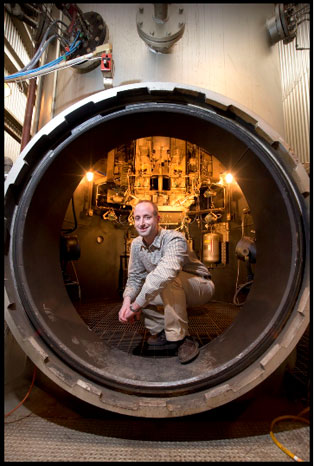
Pictured: Tom Donnelly, Moog Propulsion Test Manager, inside one of the rocket test cells at his company’s Niagara Falls, New York facility.
[SatNews] Engines fired for the military, Sandia, MELCO and others were 50 percent more in 2012 than 2011, and more than 100 percent of those tested in 2010.
In the past year, Moog ISP, part of Moog Inc.’s Space and Defense Group, successfully conducted more than 7,900 hot fire tests on 400 engines for at least 14 different customers. Along with testing engines and a variety of propellants and propulsion systems, Moog ISP manufactures liquid rocket engines, tanks and propulsion systems for satellites and launch vehicles.
Moog ISP conducts hot fire tests at its Niagara Falls, New York facility which includes four vacuum-capable rocket test cells and one sea-level-capable rocket test cell. In 2012, Moog performed hot fire tests on engines (ranging in thrust levels from approximately 250 lbf to less than 1 lbf) for commercial and military clients, including Sandia and MELCO.
“When selecting spacecraft instruments, performance and reliability are the most important criteria,” said Masato Kotani, system engineer at MELCO. “We work with Moog ISP because we have always been completely satisfied with the in-orbit performance of their products.”
According to Thomas Donnelly, Propulsion Test Manager for Moog ISP, the number of engines fired in 2012 was approximately 50 percent higher than the mark hit in 2011. And the total number of engines hot fire tested in 2012 exceeded the amount fired in 2010 by more than 100 percent.

“The utilization rate for our five test cells is approximately 90 percent, and we are now building a sixth vacuum-capable rocket test cell in Niagara Falls that we expect to operate by the end of 2013,” said Donnelly.
Moog ISP usually assembles all of the engines and propulsion systems it tests at its Niagara Falls facility. Once an engine is tested for pressure, flow and vibration, it is then hot fired to verify performance characteristics such as thrust and chamber temperature prior to delivery to the customer.