

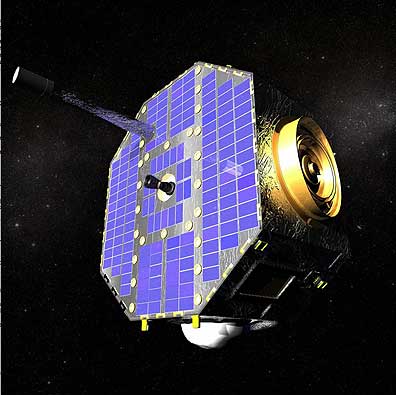
Artist concept of the IBEX satellite. Credit: NASA/Goddard Space Flight Center
From NASA's IBEX site .:
Imagine floating 35,000 miles above the sunny side of Earth. Our home planet gleams below, a majestic whorl of color and texture. All seems calm around you. With no satellites or space debris to dodge, you can just relax and enjoy the black emptiness of space.
But looks can be deceiving.
In reality, you've unknowingly jumped into an invisible mosh pit of electromagnetic mayhem — the place in space where a supersonic "wind" of charged particles from the Sun crashes head-on into the protective magnetic bubble that surrounds our planet. Traveling at a million miles per hour, the solar wind's protons and electrons sense Earth's magnetosphere too late to flow smoothly around it. Instead, they're shocked, heated, and slowed almost to a stop as they pile up along its outer boundary, the magnetopause, before getting diverted sideways.
Space physicists have had a general sense of these dynamic goings-on for decades. But it wasn't until the advent of the Interstellar Boundary Explorer or IBEX, a NASA spacecraft launched in October 2008, that they've been able to see what the human eye cannot: the first-ever images of this electromagnetic crash scene. They can now witness how some of the solar wind's charged particles are being neutralized by gas escaping from Earth's atmosphere.
A New Way to See Atoms
IBEX wasn't designed to keep tabs on Earth's magnetosphere. Instead, its job is to map interactions occurring far beyond the planets, 8 to 10 billion miles away, where the Sun's own magnetic bubble, the heliosphere, meets interstellar space.
Only two spacecraft, Voyagers 1 and 2, have ventured far enough to probe this region directly. IBEX, which travels in a looping, 8-day-long orbit around Earth, stays much closer to home, but it carries a pair of detectors that can observe the interaction region from afar.
The briefing participants are:
- Arik Posner, IBEX program scientist, Heliophysics Division, Science Mission Directorate, NASA Headquarters in Washington
- Nathan Schwadron, IBEX science operations lead and associate professor at the University of New Hampshire in Durham
- David McComas, IBEX principal investigator and assistant vice president of the Space Science and Engineering Division at Southwest Research Institute in San Antonio
- Merav Opher, associate professor, George Mason University in Fairfax, Virginia