

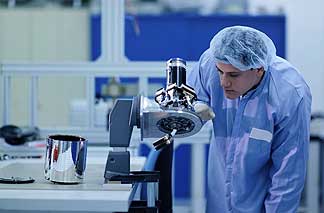
A RUAG Space Employee in Zurich, Switzerland assembles a Solar Array Drive Mechanism for Galileo. Photo: RUAG Space
“Participation in the Galileo project not only represents a major business deal for RUAG but also confirms the strategic direction being taken by our Space division,” explained Peter Guggenbach. “We have gathered a number of different niche space suppliers under the RUAG umbrella. As Europe's largest independent supplier, we are now able to offer a comprehensive product portfolio,” added the CEO of RUAG Space.
In the future, Galileo will provide Europe with its very own satellite navigation system independent from the American GPS system. In contrast to the USA's military system, Galileo has been designed as a civil system and optimized for the needs of private and commercial users. Just like GPS, Galileo will transmit a signal that can be received free of charge by users everywhere. Future navigation receivers will be able to process the signals from Galileo and GPS satellites simultaneously. Users will benefit from improved satellite reception and, ultimately, from more accurate location-finding capabilities. The Galileo program is supported by European Union funding, while Switzerland has signed a bilateral agreement to allow it to participate in the Galileo program.
The Galileo constellation will ultimately consist of a total of up to 30 satellites. Construction of the first four satellites is already underway, with RUAG Space playing a significant role. In January, the German space company OHB was commissioned by the European Commission to build 14 satellites. Contracts are still to be awarded for the construction of further satellites.
The central control computers for the Galileo satellites will be manufactured by RUAG Space in Gothenburg, Sweden. These computers are designed to control and monitor the navigation payload and numerous other subsystems. They will also control the temperature and power distribution onboard the satellites. RUAG Space Austria is also involved in the process of developing and building these computers. Further contributions from Sweden include antennas for internal system communications and processor boards for the navigation satellites' digital radio receivers.
RUAG Space facilities in Zurich, Switzerland, will be supplying the mechanisms used to align the Galileo satellites’ solar array. As a satellite orbits the Earth, it continuously changes its alignment to the sun. Special mechanisms known as SADMs (Solar Array Drive Mechanisms) ensure that the solar array precisely tracks these changes in order to obtain the maximum energy yield by optimizing the orientation of the solar cells relative to the sun.
At its site in Vienna, Austria, RUAG Space is producing a special thermal insulation blanket. The Galileo satellites will be ‘wrapped up’ almost entirely in this blanket to ensure that the sensitive onboard electronics are not damaged by the extreme temperature fluctuations encountered by the satellites in space.