

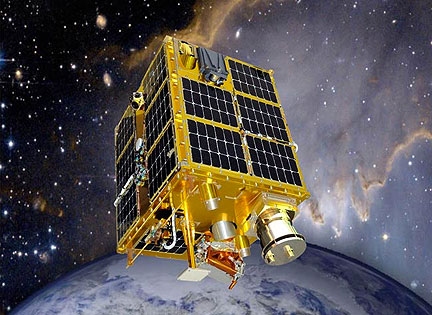
Artistic rendition of the FASTSAT microsat
One year ago, on November 19, 2010, FASTSAT-HSV01, the Fast, Affordable, Science and Technology Satellite, successfully launched aboard a Minotaur IV rocket from Kodiak, Alaska. The micro-satellite, developed by Dynetics in partnership with NASA’s Marshall Space Flight Center (MSFC) and the Von Braun Center for Science and Innovation (VCSI), has met significant milestones since its launch, resulting in an extension on orbit, now through April 2012. FASTSAT was designed to carry multiple small payloads to low-Earth orbit, creating opportunities for researchers to conduct low-cost scientific and technology research on an autonomous satellite in space.
“Dynetics invested in the development of the satellite as a rapid, affordable alternative to the traditional cost models in the micro-satellite space market,” said Steve Cook, director of Space Technologies. FASTSAT-HSV01 was part of the Department of Defense Space Test Program (DoD STP)-S26 flight.
“The satellite carried six DoD payloads, giving them all the opportunity to raise their technology readiness and collect valuable scientific and technical data in less than two years,” said Mike Graves, Dynetics’ space vehicles department manager. Spacecraft and payload operations have been performed from at the MSFC Huntsville Operations Support Center (HOSC) for the past 12 months and successfully distributed data to the principal investigators at Goddard Space Flight Center and Air Force Research Laboratories. The mission completed the minimum 9 month of science operations and also demonstrated the first deployment of a CubeSat (NASA’s NanoSail-D) from an ESPA class satellite on-orbit. The Dynetics team provided procurement services, manufacturing, assembly, integration and test and ground operations for the project, as well as extensive engineering support for avionics, communications, software and mission operations, according to Cook.
The satellite was ready for launch in a very short timeframe, Graves said. “FASTSAT was developed, integrated, tested and certified for flight in 17 months using an innovative business model, tailored processes and a co-located and experienced team,” he said.
“We are very pleased with the success of this first FASTSAT,” said David King, executive vice president at Dynetics. “This is a significant achievement for Dynetics and our partners because it demonstrates the capability to provide rapid, low-cost access to space to experiment with new technologies and meet tactical operational needs.”