

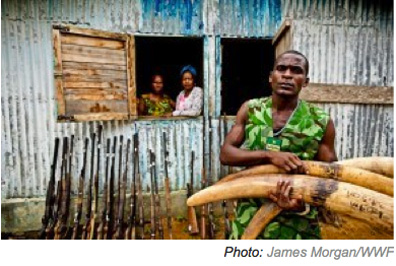
A Gabon Eco Guard displaying seized poached elephant tusks and poacher's weapons, Oyem, Gabon.
International NGO African Parks employs approximately 130 rangers who are charged with patrolling Garamba. However, they are outmanned and sometimes outgunned. Peter Fearnhead, Chief Executive Officer of African Parks, which has jurisdiction and which manages the park on behalf of the Congolese wildlife authority called the Institut Congolais pour la Conservation de la Nature, said, "The Lord's Resistance Army is now part of a larger poaching crisis that is decimating elephants throughout central Africa. The high price of ivory is increasingly incentivizing the involvement of armed groups such as the LRA, sustaining their atrocities in the region. Given the presence of the LRA in Garamba, the Park's elephants are particularly under threat. In the 1970s, 20,000 elephants roamed Garamba. Today, our management is fighting to conserve the remaining 1,800 to 2,500 elephants. But the battle is far from lost. With more training, better equipment, and intelligence support, Garamba's elephants will be saved."
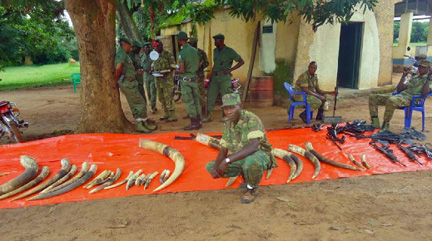
Rangers display ivory tusks recovered in Garamba.
NURIA ORTEGA / AFRICAN PARKS NETWORK
Report co-author Jonathan Hutson, Director of Communications for the Enough Project and the Satellite Sentinel Project, said, "African wildlife parks have become automated teller machines for armed groups that commit atrocities. They find a readily available source of support in poaching elephants and other protected species. That is a driver which contributes to record levels of poaching. Of course, the LRA is not the only group benefiting from the surging black market for ivory. Park rangers suspect that members of the Congolese, Sudanese, South Sudanese, and Ugandan armed forces, as well as janjaweed militias from Darfur, are killing elephants at an accelerating pace."
Since 2005, Garamba has been one of the LRA's hiding places in central Africa. However, the LRA's elephant poaching was not previously documented. Multiple sources report that a group of heavily armed LRA fighters have picked up tusks from rendezvous points in Garamba and transported them north through the Central African Republic towards Sudan. An LRA defector reported that his group, based in the Kafia Kingi enclave—a disputed border region between Sudan and South Sudan—sold tusks poached in Congo to members of the Sudan Armed Forces.
The report concludes that the resources gained from the illegal trade of ivory undercut the efforts of the African Union Regional Task Force soldiers to combat the LRA and undermine the mission of U.S. military advisors to assist their work. Read the report, "Kony's Ivory: How Elephant Poaching in Congo Helps Support the Lord's Resistance Army". (Source: AllAfrica.)