

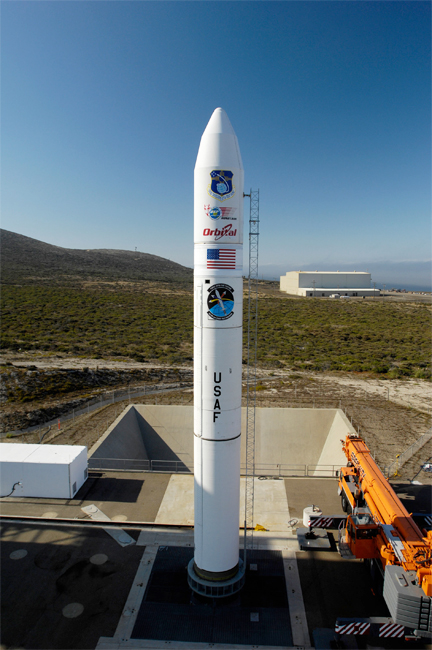
Image courtesy of Orbital Sciences Corporation
...launch service contracts to Space Exploration Technologies, Orbital Sciences Corporation and Lockheed Martin Space Systems Corporation. The potential $900 million, 5-year contract, known as Orbital/Suborbital Program 3, provides small launch services (referred to as Lane 1) capable of lifting up to 4,000 pounds into Low-Earth Orbit (LEO), and higher capability services (referred to as Lane 2) for larger scale space lift missions in order to meet a wide range of U.S Government requirements. Small launch services were previously procured under the Orbital/Suborbital Program 2, which expires in early 2013.
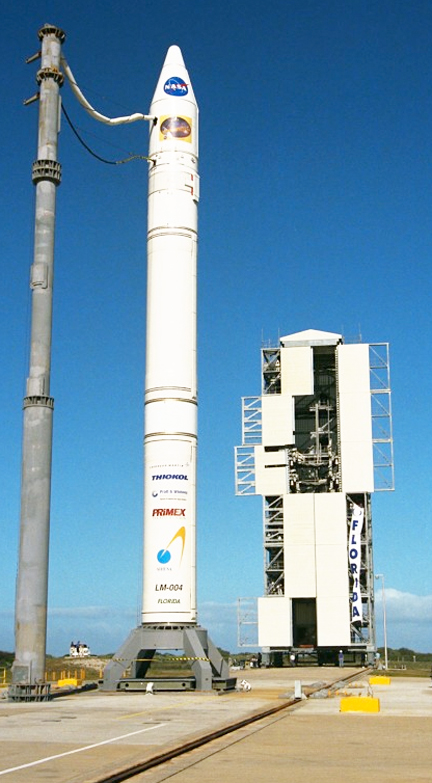
Athena launch vehicle photo courtesy of Lockheed Martin
In addition to the basic contract, two initial task orders were awarded to SpaceX to launch the Deep Space Climate Observatory satellite and the Space Test Program 2 payload suite in 2014 and 2015, respectively. The DSCOVR mission will fly on SpaceX’s Falcon 9 upgrade to deliver a NASA-built satellite to the L1 Earth-Sun La Grange point, where it will provide solar weather and earth observation data for the National Oceanic and Atmospheric Agency.
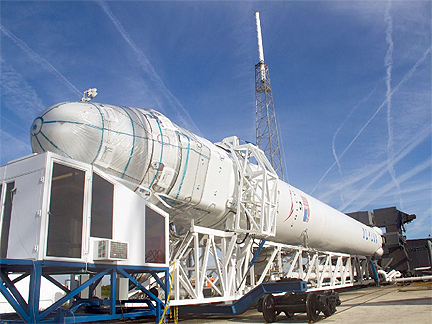
SpaceX Falcon 9 launch vehicle
The second mission, STP-2, will launch aboard SpaceX’s Falcon Heavy. STP-2 will deliver a wide variety of experimental and prototype payloads to several orbits. Both these missions are designated for Evolved Expendable Launch Vehicle “New Entrants” and will facilitate the introduction of new competitors into EELV’s current family of medium and larger class rockets.