

 [SatNews] Three spills from ships in the Black Sea have been captured...
Spills from ships, detected during satellite-based monitoring on 15th September 2011 in north-eastern part of the Black Sea were detected again during monitoring from satellites. RADARSAT-1 radar image, received and processed by ScanEx RDC on September 15th reveals three spills of ship origin with acreage of 14.6, 18 and 20 sq.km respectively. The spills were in the open sea at the distance 37 to 90 km from the coast in Ukrainian and partially in Russian sectors. The largest spill occurred within the Ukrainian sector (on the border with the Russian one) from the ship that presumably was heading to Novorossiysk port. Moreover, the appearance of spills on the image, received in morning hours, means the ship dumps was made during the nighttime. Specialists, conducting satellite-based monitoring, leave open the possibility that these ship dumps are illegal. The investigation is ongoing.
Appearance of oily substances in the waters is often related to the flushing of tanks, dumping of bilge water, and so on. Such procedures are frequently carried out in the open sea at the distance of 50 to 100 km from the seashore and beyond the 12-mile (22 kilometers) maritime belt zone, where it is strictly prohibited to do that. Tanks are being flushed and cleaned mostly from vegetable oils and other oily substances that are according to MAPROL (the International Convention for the Prevention of Pollution From Ships) convention are harmless for human health and the environment.
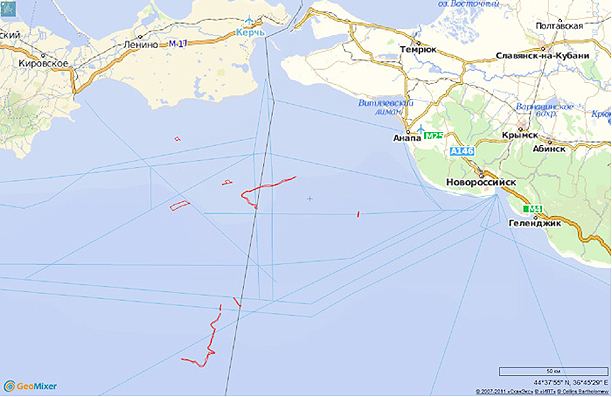
Spills from ships, detected during satellite-based monitoring on 15th September 2011 in north-eastern part of the Black Sea. Image courtesy of ScanEx.
"The convention allows dumping of treated bilge water from engine compartments even within the “special area”, which is the Black Sea, if certain requirements are met: water must be cleaned by the oil-water separator that is equipped with automatic stop valve with an alarm in case of excess in mass fraction of oil products of 15 ppm. In addition, bilge waters must not be mixed with the remains of load being transported," said Chief Specialist of FSU “Administration of the Novorossiysk Sea Port” Michael Flyaum.