

...successfully launched the company-built Nuclear Spectroscopic Array Telescope (NuSTAR) satellite for the National Aeronautics and Space Administration (NASA) into its intended orbit. Early results indicate that the NuSTAR satellite is operating as expected at this stage of its mission.
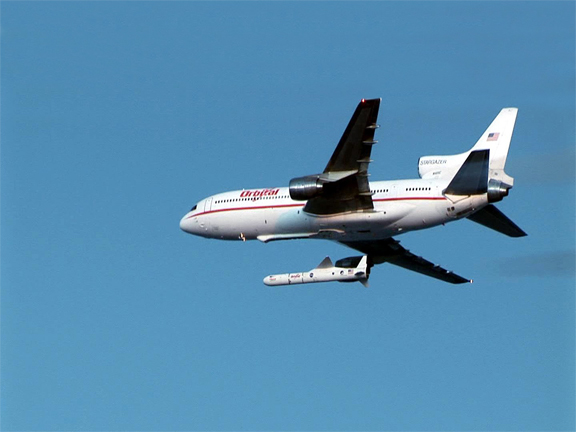
The “Stargazer” carrier aircraft taking off from Kwajalein Atoll in the South Pacific on its 27th successful Pegasus mission. Pegasus has launched from six different sites worldwide, the first time a space launch vehicle has demonstrated such operational flexibility.
The Pegasus/NuSTAR mission originated from the U.S. Army’s Reagan Test Site, Kwajalein Atoll, which is a part of the Marshall Islands in the mid-Pacific Ocean. Following a one-hour preplanned positioning flight, the Pegasus rocket was released from Orbital’s L-1011 carrier aircraft at approximately 12:00 p.m. (EDT). After a 13-minute powered flight sequence, Pegasus launched the 770 lb. NuSTAR satellite into its targeted circular orbit approximately 400 miles above the Earth.
 Orbital designed, manufactured and tested the NuSTAR satellite at its Dulles, Virginia, satellite manufacturing facility. The Pegasus rocket was assembled and tested at company facilities at Vandenberg Air Force Base, California. Today’s successful launch by the Pegasus rocket was the 27th consecutive successful mission for the Pegasus program over a 15-year period and the 41st overall flight of the company’s unique air-launched system since its introduction in 1990.
“We are very pleased to support NASA and JPL on this important scientific project,” said Mr. Ron Grabe, Orbital’s Executive Vice President and General Manager of its Launch Systems Group. “The NuSTAR program is another ‘dual’ mission for our launch vehicle and satellite engineering teams, building on our history of supporting successful NASA scientific programs such as AIM, GALEX, SORCE, ACRIMSAT and IBEX with our launch vehicles and satellite platforms.”