

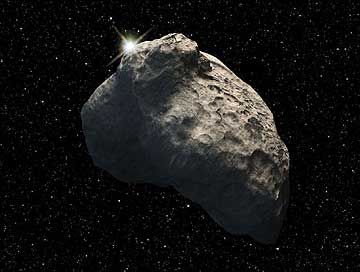
The smallest Kuiper Belt Object (KBO) seen previously in reflected light is roughly 30 miles across, or 50 times larger. Hubble observations of nearby stars show that a number of them have Kuiper Belt-like disks of icy debris encircling them. These disks are the remnants of planetary formation. Researchers surmise that over billions of years the debris should collide, grinding the KBO-type objects down to ever smaller pieces that were not part of the original Kuiper Belt population. The finding is a powerful illustration of scientists' ability to use archived Hubble data to produce important new discoveries. Image Credit: NASA