

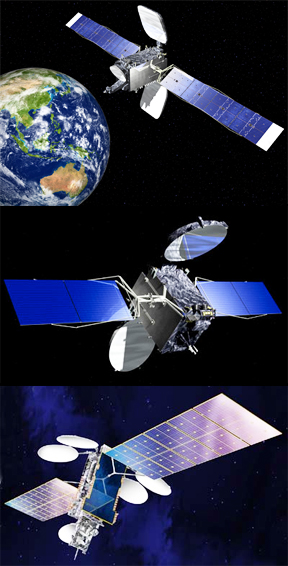
Artistic renditions of SES' satellites... from top to bottom, SES-8, NSS-9 and NSS-6.
...are driving the demand for satellite capacity in the region. With the number of channels offered by DTH platforms in Southeast Asia projected to reach 1,600 by 2016, SES is ramping up investment activities in Asia-Pacific to meet the increasing demand for satellite capacity. SES' current committed investment in Asia includes SES-8, which is due to launch in the first quarter of 2013. The satellite will deliver vital expansion capacity to thriving Asian video neighbourhoods in South Asia and Indochina. SES-8 will be the first geostationary satellite launched by SpaceX on a Falcon 9 rocket. Additionally, SES is looking for further growth opportunities and sees the potential to invest in one to two additional satellites to deliver increased satellite capacity and coverage in Asia-Pacific beyond 2014. The new satellites will help fuel the growth in the payTV markets and the maritime industry in the region.
Additionally, SES announced at CommunicAsia2012 that it has signed a new multi-year capacity deal...
...with Telikom Papua New Guinea (Telikom PNG), the country’s incumbent telecommunications operator. The deal involves a renewal of satellite capacity on NSS-9 at 183 degrees East and on NSS-6 at 95 degrees East. In total, Telikom PNG currently contracts more than 100 MHz in capacity with SES and is one of SES’ largest customers in Papua New Guinea. The renewal will enable Telikom PNG to continue expanding its cellular services into new regions and provide telephone services over challenging mountainous terrain by providing cellular backhaul between a large number of sites around the country and the capital, Port Moresby.