

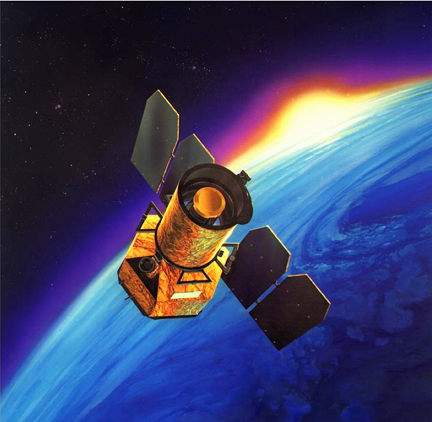
The Galaxy Evolution Explorer was launched on April 28, 2003. Its mission is to study the shape, brightness, size and distance of galaxies across 10 billion years of cosmic history. The 50-centimeter-diameter (19.7-inch) telescope onboard the Galaxy Evolution Explorer sweeps the skies in search of ultraviolet-light sources. Image credit: NASA/JPL-Caltech
"The gas in this galaxy is being blown back into a turbulent wake," said Janice Hester of the California Institute of Technology in Pasadena, lead author of a recent study published in the Astrophysical Journal Letters. "The gas is like sand caught up by a stiff wind. However, the particular type of gas that is needed to make stars is heavier, like pebbles, and can't be blown out of the galaxy. The new Galaxy Evolution Explorer observations are teaching us that this heavier, star-forming gas can form in the wake, possibly in swirling eddies of gas."
Collisions between galaxies are a fairly common occurrence in the universe. Our Milky Way galaxy will crash into the Andromeda galaxy in a few billion years. Galaxies tangle together, kicking gas and dust all around. Often the battered galaxies are left with tails of material stripped off during the violence. Hester and her team studied the tail of IC 3418, which formed in a very different way. IC 3418 is mingling not with one galaxy, but with the entire Virgo cluster of galaxies 54 million light-years away from Earth. This massive cluster, which contains about 1,500 galaxies and is permeated by hot gas, is pulling in IC 3418, causing it to plunge through the cluster's gas at a rate of 1,000 kilometers per second, or more than 2 million miles per hour. At this incredible speed, the little galaxy's gas is being shoved back into a choppy tail.
The astronomers were able to find this tail with the help of the Galaxy Evolution Explorer. Clusters of massive, young stars speckle the tail, and these stars glow with ultraviolet light that the space telescope can see. The young stars tell scientists that a crucial ingredient for star formation - dense clouds of gas called molecular hydrogen - formed in the wake of this galaxy's plunge. This is the first time astronomers have found solid evidence that clouds of molecular hydrogen can form under the violent conditions present in a turbulent wake. Caltech leads the Galaxy Evolution Explorer mission and is responsible for science operations and data analysis. NASA's Jet Propulsion Laboratory in Pasadena manages the mission and built the science instrument. The mission was developed under NASA's Explorers Program managed by the Goddard Space Flight Center, Greenbelt, Md. Researchers sponsored by Yonsei University in South Korea and the Centre National d'Etudes Spatiales (CNES) in France collaborated on this mission.
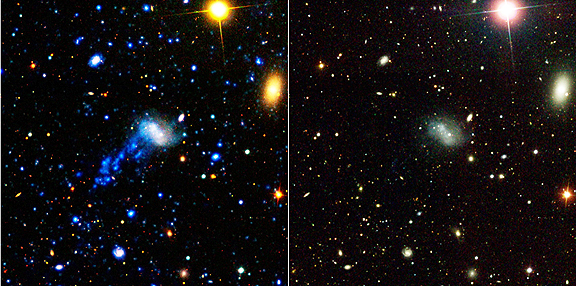
NASA's Galaxy Evolution Explorer found a tail behind a galaxy called IC 3418. The star-studded tail can be seen on the left, as detected by the space telescope in ultraviolet light. The tail has escaped detection in visible light, as shown by the image on the right, taken by a visible-light telescope on the ground. This tail was created as the galaxy plunged into gas in a family of galaxies known as the Virgo cluster. The image on the left is a composite of data from the Galaxy Evolution Explorer (far-ultraviolet light is dark blue and near-ultraviolet light is light blue); and the Sloan Digital Sky Survey (visible light is colored green and red). The image on the right is from the Sloan Digital Sky Survey. Other galaxies and stars can be seen scattered throughout the image. Another galaxy called IC 3413, which is part of the Virgo cluster, can be seen to the right of IC 3418 as an oval-shaped blob. The bright large dot at upper right is a star in our Milky Way galaxy. Image Credit: NASA/JPL-Caltech