

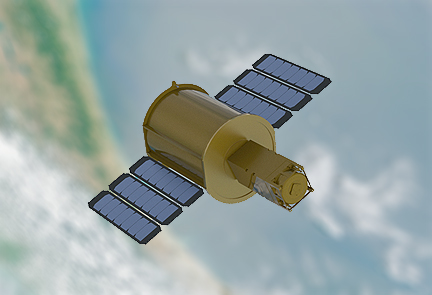
Artistic rendition of the SeeMe satellite, courtesy of Raytheon
...birds-eye view of the battlefield at a fraction of the cost of other sensors. SeeMe satellites, now in development at Raytheon, will give warfighters a nearly instant, zoomed-in view of enemies in the next canyon or behind a hill. The satellites will beam images to existing communication devices, and eventually to smartphones.
“We’re putting near-real time data where the warfighter needs it—directly into their hands—and providing them with vital, tactical intelligence they can control,” said Tom Bussing, vice president of Advanced Missile Systems at Raytheon Missile Systems.
In December the Defense Advanced Research Projects Agency (DARPA) awarded Raytheon a $1.5 million development contract for the satellites. The agency says it wants small, “disposable” satellites that can transmit directly to the field. The name SeeMe stands for Space Enabled Effects for Military Engagements. Raytheon hopes to eventually build six of the satellites for ground testing under phase two of the contract. Commanders could position a “constellation” of 24 satellites in low-earth orbit so that one is in range every 90 minutes. Weighing less than 25 pounds, the satellites would measure less than 3 feet long, be about a foot in diameter and capable of staying in orbit for a minimum of 45 days.
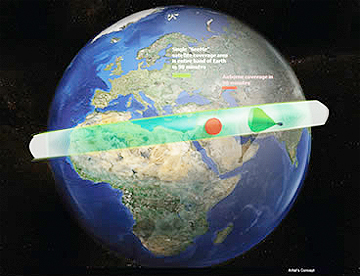
A DARPA artistic concept graphic of the SeeMe satellite, which can circle the Earth every 90 minutes.
The company has a long history of making civilian space products. Its Visible Infrared Imaging Radiometer Suite (VIIRS), a sensor package on the Suomi NPP satellite, is delivering stunning new images of Earth. Raytheon-built radar equipment is aboard both NASA’s Lunar Reconnaissance Orbiter and India’s Chandrayaan spacecraft. The cost of a traditional, multi-function satellite can run into tens of millions of dollars, but at full production rates each SeeMe satellite should cost less than $500,000. Using a booster provided by the DARPA ALASA (Airborne Launch Assist Space Access) program, total launch costs would be $1.5 million per SeeMe satellite.
For the initial contract, Raytheon has teamed with Sierra Nevada Corp., the University of Arizona and SRI International to assist with the design work and eventual production.