

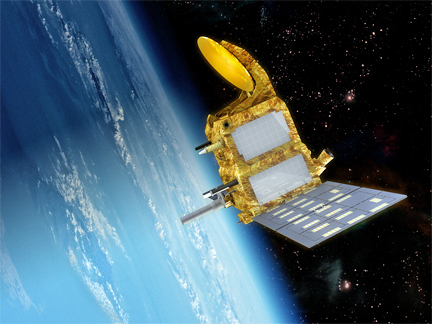
Artistic rendition of the Saral satellite, courtesy of CNES
...yet another milestone on Monday after the PSLV-C20, in its 22nd consecutive successful launch, placed into orbit the Indo-French satellite Saral for ocean and marine studies and six other satellites.
Taking off under a clear sky from the first launchpad at Sriharikota at 6:01 p.m., the 44.40m tall rocket, weighing 230 tons, headed into its flight-path as President Pranab Mukherjee along with top ISRO scientists and other dignitaries watched from the control center. The Saral mission was earlier scheduled for launch in December 2012, but had to be put off until Isro had to resolve some technical glitches in the joint satellite project. The launch-window on Monday was fixed for 5:56 p.m., but during the countdown was rescheduled to take off five minutes later. This was “possibly to avoid the rocket colluding with any space debris,” anticipated earlier today, a source said.
Saral is the 56th satellite to be launched by the PSLV for ISRO, making another happy relieving moment for the space agency’s chairman K. Radhakrishnan, who sat through the flight duration nervously until all the seven satellites were successfully separated from the launch vehicle. A sigh of relief occurred when Saral first separated with almost clock-work precision at about 1,077 seconds after the rocket’s take-off.
While ISRO has built this new ‘satellite bus’, the two payloads comprising Saral, namely Argos and Altika, weighing 407kg., were built by the French National Space Agency (CNES). The Saral satellite also carries a C-band transponder payload for “ground radar collaboration support”, ISRO officials said. The satellite will be put into a variety of ocean-related uses, from studying the ocean currents circulation, sea surface elevation, climate monitoring, sea state forecasting to marine animal movements.
After ejecting Saral, the PSLV-C20 injected the other six smaller commercial satellites into their respective orbits with amazing rapidity, which included two satellites from Canada, “Sapphire” (148kg.), “Neossat” (74kg.), two research satellites built for the University of Austria, “Unibrite” (14kg.), “Brite” (14kg.), a nano-satellite “Aausat-3” weighing 3kg. for Denmark’s Aalborg University and “STRaND-1” (6.5kg.) for the UK-based company, Surrey Satellite Technology Limited (SSTL).