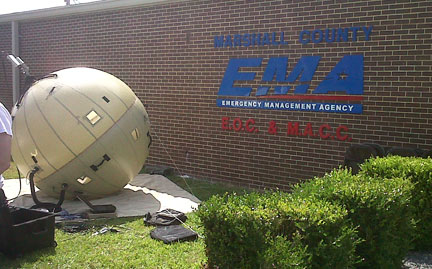
[SatNews] GATR Technologies announced its recent support of local emergency response agencies and tornado victims in North Alabama and surrounding area with critical satellite connectivity (via the GATR inflatable antenna system) and personnel in the wake of the tornados that ripped through Alabama on April 27th.
Communication links (phone, internet, and some cell services) were severely impaired with over 600,000 residences and businesses throughout North Alabama suffering power disruption for nearly a week. As emergency and utility crews worked through the night after the storms hit and the following days, GATR’s response team contacted local emergency response agencies offering connectivity for critical emergency management operations. In addition, GATR also supplied Wi-Fi Internet connections for victims to contact family and friends in the areas where all communication lines were down and cell coverage was limited or inoperable. GATR donated satellite link time and deployed 9 antennas throughout the upper-half of Alabama. Several antennas are still in operation.
GATR’s inflatable antennas have been providing communications to emergency responders, community leaders, and affected residents since the morning after (4/28/11) the storms that generated tornados in the southeast United States. “We are always prepared to quickly respond with our technology in the wake of catastrophic events, but we didn’t expect to respond to a disaster in our own community,” said Paul Gierow, President at GATR Technologies. “This is exactly what our products are geared for… first-in deployments, remote applications and contingency scenarios.” Agencies, victims, volunteers, and companies all were impressed with the ‘Ball of Connectivity,’ even though it operates exactly like a precision rigid satellite dish/terminal; the unique inflated ball, designed for extreme portability, always attracts attention. The GATR is currently used by U.S. Military, Intelligence, and Homeland Security (FEMA) organizations to provide first-in communications in remote areas and contingency situations at Ku-, C-, and X-band.