

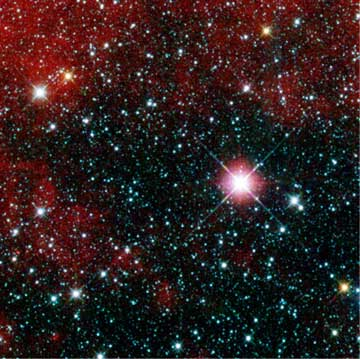
WISE First-Light image. Image credit: NASA/JPL-Caltech/UCLA
When the WISE survey begins, the spacecraft will scan the sky continuously as it circles the globe, while an internal scan mirror counteracts its motion. This allows WISE to take "freeze-frame" snapshots every 11 seconds, resulting in millions of images of the entire sky. To sense the infrared glow of stars and galaxies, the WISE spacecraft cannot give off any detectable infrared light of its own. This is accomplished by chilling the telescope and detectors to ultra-cold temperatures. The coldest of WISE's detectors will operate at less than 8 Kelvin, or minus 445 Fahrenheit. The first sky survey will be complete in six months, followed by a second scan of one-half of the sky lasting three months. The WISE mission ends when the frozen hydrogen that keeps the instrument cold evaporates away, an event expected to occur in October 2010. Preliminary survey images are expected to be released six months later, in April 2011, with the final atlas and catalog coming after another 11 months in March 2012. Selected images will be released to the public beginning in February 2010.