


Artistic impression of the James Webb Space Telescope (JWST), Credit: NASA
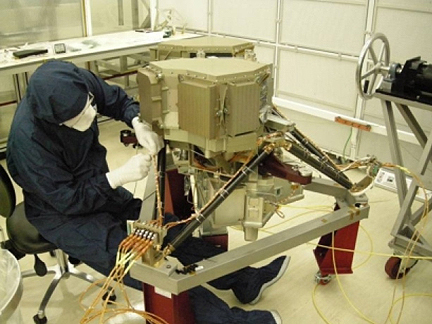
The MIRI instrument pictured in the clean room at the Rutherford Appleton Laboratory, UK, during integration of the flight model, in Summer 2010. Copyright MIRI European Consortium/RAL
In Spring this year, the flight model of MIRI began to take shape as the key sub-assemblies - the imager, the spectrometer optics, and the input-optics and calibration module - were delivered to RAL for integration. Each of the optical sub-assemblies of MIRI had at that stage already, separately, undergone exhaustive mechanical and thermal testing to make sure they can not only survive the rigours of a journey to L2, but also remain operational for the life of the mission. At RAL, the sub-assemblies were integrated into the flight model and are now being tested again, as a complete instrument, using a specially designed chamber developed at RAL to reproduce the environment at L2. For the purposes of these environmental and calibration tests the JWST telescope optics are simulated using the MIRI Telescope Simulator (MTS) that was built in Spain. Following completion of these tests, the MIRI will be shipped to NASA's Goddard Space Flight Center in the US, next spring, when the instrument will be integrated with the JWST Integrated Science Instrument Module. When MIRI eventually reaches its sheltered position, located four times further away from the Earth than the Moon, scientists can begin probing the Universe's secrets, including its earliest days.
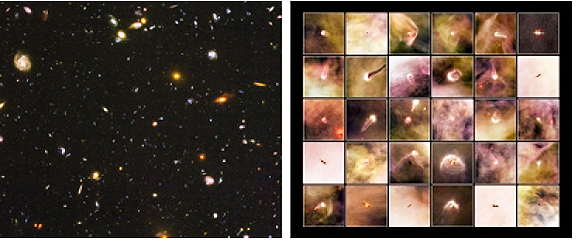
Left: Hubble Ultra Deep Field. MIRI will play a key role in demonstrating which galaxies are undergoing their first episodes of star formation. Credit: NASA, ESA, and S. Beckwith (STScI) and the HUDF Team. Right: Hubble images of protoplanetary discs. MIRI will provide images of unsurpassed detail. Credit: NASA/ESA and L. Ricci (ESO)