

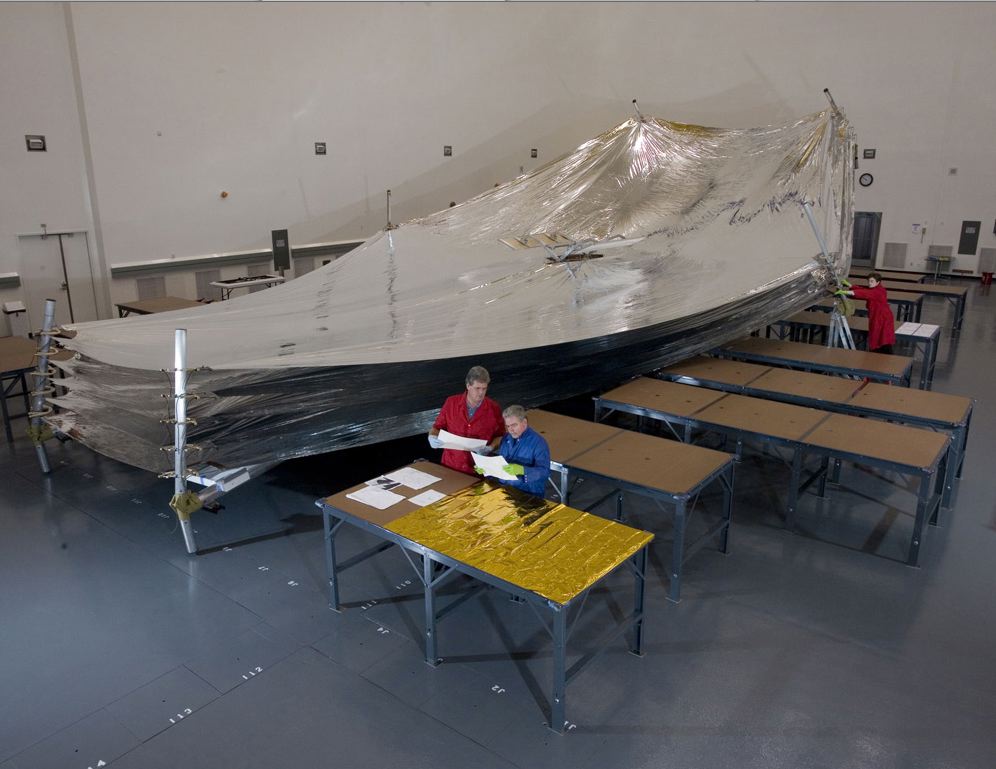
The five-layer James Webb Space Telescope sunshield consists of thin membranes made from a polymer-based film and supporting equipment such as spreader bars, booms, cabling, and containment shells. Designed to block solar light and keep the Observatory operating at cryogenic temperatures. Credit: NASA/Northrop Grumman
NASA is testing an element of the sunshield that will protect the James Webb Space Telescope's mirrors and instruments during its mission to observe the most distant objects in the universe.
The sunshield will consist of five tennis court-sized layers to allow the Webb telescope to cool to its cryogenic operating temperature of minus 387.7 degrees Fahrenheit (40 Kelvin).
The 2,000-pound platform that engineers will use to precisely align the Webb telescope's enormous five-layer sunshield is completed, with work slated to begin on flight-like template membranes early next year. Northrop Grumman Corporation (NYSE:NOC) is leading the design and development effort for NASA's Goddard Space Flight Center, Greenbelt, Maryland.
"The sunshield has now moved to a very significant pre-flight level of development as we continue to meet the challenges of engineering this one-of-a-kind component," said Scott Willoughby, vice president and Webb Telescope program manager for Northrop Grumman Aerospace Systems. "Together with the recent completion of the mirrors, we are making noteworthy progress through the telescope's integration and test phase."
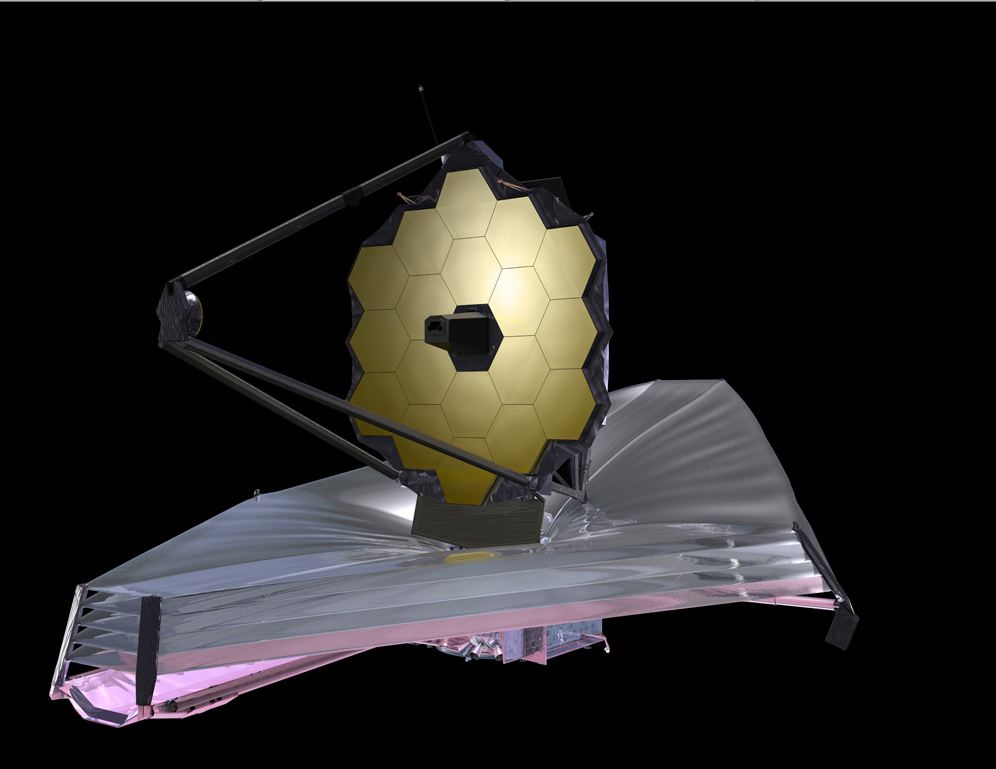
September 2009 artist conception of the James Webb Space Telescope, with the 5 layer sunshield stretched out in space. Credit: NASA
The sunshield membrane layers, each as thin as a human hair, are made of Kapton, a very tough, high performance plastic with a reflective metallic coating. Each one of five "template" or pre-flight model layers will be laid out on the table where holes will be made in the exact locations needed to attach the layers to the structure for launch. To ensure proper fit and function, the hole positions are different for each layer and their locations are controlled to a small fraction of an inch.
Hole positioning is a critical task because the sunshield layers must be held in a predetermined configuration to survive launch so that they can later unfold in a carefully orchestrated way.
The observatory will be pointed so that the Sun, Earth and Moon are always on one side, with the sunshield acting like an umbrella to protect the telescope (the mirrors and instruments) from the heat of the sun and warm spacecraft electronics. The sunshield will passively cool the telescope to a temperature of -375 degrees F, which is needed to prevent the observatory's own heat from "blinding" its infrared sensing instruments.
The process will begin on the five template membranes in January 2012 and continue through the year, interspersed with fit checks on a full-size mock-up of the telescope at Northrop Grumman's manufacturing facility in Redondo Beach. Construction of the five flight membranes is slated to begin in mid-2013.
Successor to the Hubble Space Telescope, the James Webb Space Telescope is the world's next-generation space observatory. It is the most powerful space telescope ever built. Webb will observe the most distant objects in the universe, provide images of the very first galaxies ever formed and study planets around distant stars. The Webb Telescope is a joint project of NASA, the European Space Agency and the Canadian Space Agency.