

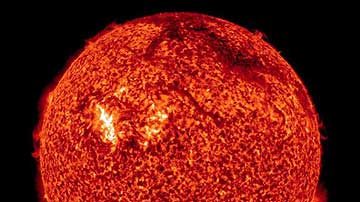
NASA's Solar Dynamics Observatory snapped this X-ray photo of the Sun early in the morning of Sunday, August 1st. The dark arc near the top right edge of the image is a filament of plasma blasting off the surface -- part of the coronal mass ejection. The bright region is an unassociated solar flare.
That's the surprising conclusion of a NASA-funded study by the National Academy of Sciences entitled Severe Space Weather Events — Understanding Societal and Economic Impacts. In the 132-page report, experts detailed what might happen to our modern, high-tech society in the event of a "super solar flare" followed by an extreme geomagnetic storm. They found that almost nothing is immune from space weather — not even the water in your bathroom.
Okay, so today's announcement from NASA indicates that Earth is bracing for a cosmic tsunami Tuesday night as tons of plasma from a massive solar flare head directly toward the planet.
The Sun's surface erupted early Sunday morning, shooting a wall of ionized atoms directly at Earth, scientists say. It is expected to create a geomagnetic storm and a spectacular light show — and it could pose a threat to satellites in orbit, as well.
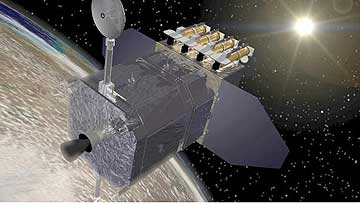
NASA SDO in Orbit Source: NASA
The solar eruption, called a coronal mass ejection, was spotted by NASA's Solar Dynamics Observatory, which captures high-definition views of the sun at a variety of wavelengths. SDO was launched in February and peers deep into the layers of the sun, investigating the mysteries of its inner workings.
"We got a beautiful view of this eruption," Golub said. "And there might be more beautiful views to come if it triggers aurorae."
Views of aurorae are usually associated with Canada and Alaska, but even skywatchers in the northern U.S. mainland are being told they can look toward the north Tuesday and Wednesday evenings for rippling "curtains" of green and red light.
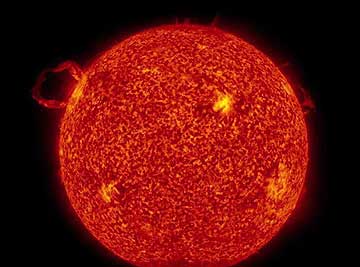
Prominence From Afar Source: NASA/Goddard Space Flight Center Scientific Visualization Studio
The flare shouldn't pose a health hazard, the atmosphere absorbs the radiation, and the magnetic field of the Earth deflects magnetic particles. Those who may be vulnerable would be pilots and passengers in airplanes, in which the exposure has been equated to receiving an X-ray.
Of interest to the satellite world is that the solar particles also could affect satellites, though scientists think that possibility is remote. Orbital Sciences Corp. believe a similar blast may have knocked its Galaxy 15 satellite permanently out of action this year. These possibilities have caused concern for both government officials and satellite manufacturers.
NASA scientists warned recently that high-energy electric pulses from the sun could cripple our electrical grid for years, causing billions in damages. In fact, the House is so concerned that the Energy and Commerce committee voted unanimously to approve a bill allocating $100 million to protect the energy grid from this rare but potentially devastating occurrence.
The sun's activity usually ebbs and flows on a fairly predictable cycle. Typically, a cycle lasts about 11 years, taking roughly 5.5 years to move from a solar minimum, a period of time when there are few sunspots, to peak at the solar maximum, during which sunspot activity is amplified. The last solar maximum occurred in 2001. The latest minimum was particularly weak and long-lasting.