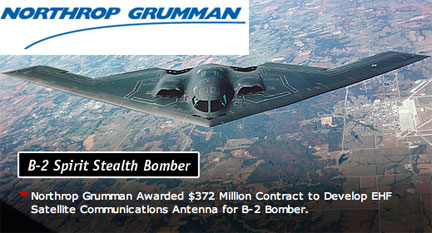
[SatNews] A new antenna system is now under development that will allow the B-2 Spirit stealth bomber to use SATCOM 100x faster than is currently possible...
Northrop Grumman Corporation (NYSE:NOC) has been awarded by the U.S. Air Force a $372 million contract to begin designing the advanced electronically scanned array (AESA) antenna system as part of Increment 2 of the B-2 extremely high frequency (EHF) satellite communications program. "Our work on the EHF antenna system takes full advantage of Northrop Grumman's expertise not only in B-2 advancement, but also in satellite communications," said Dave Mazur, vice president of long range strike and B-2 program manager for Northrop Grumman's Aerospace Systems sector. "This important enhancement will ensure that the B-2 retains its strategic communications capabilities well into the future."
Under terms of contract, the company will complete the preliminary design of the AESA antenna system, demonstrate technology readiness and prove its functionality using hardware prototypes. The required engineering design, manufacturing, assembly, integration and test activities will take place at company facilities in Palmdale, El Segundo and Redondo Beach, Calif.; Dayton, Ohio, and Tinker Air Force Base, Okla. Increment 2 is the largest effort ever undertaken to augment the lethality of the B-2 weapon system. The three-increment EHF Satcom program is part of an ongoing effort by the Air Force and Northrop Grumman to keep the B-2 fully mission capable against evolving enemy threats. Increment 1 includes enhancements to the aircraft's processing and communications infrastructure. Increment 2 involves installation of a new communications terminal and the AESA antenna. Increment 3 will integrate the B-2 into the U.S. Department of Defense's Global Information Grid, a worldwide network of information systems, processes and personnel involved in collecting, storing, managing and disseminating information on demand to warfighters, policy makers and military support personnel.