

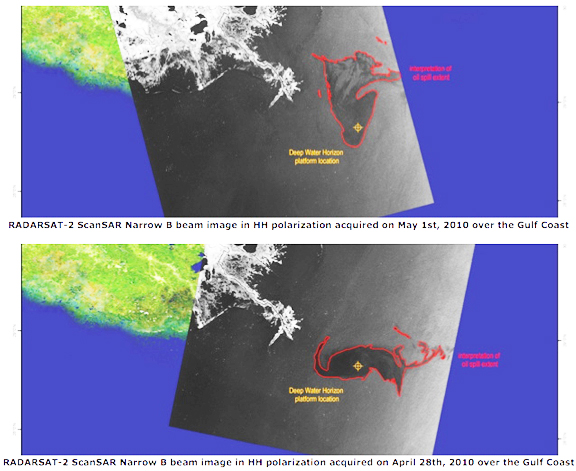
The information obtained through its surveillance service supports the decisions being made to minimize environmental impact and optimize clean-up. When events of the magnitude experienced in the Gulf Coast occurs, there is an urgent need to identify scope and direction of an oil spill. Satellite imagery acquired immediately after the event provides updated views of how the oil spill is moving, including size and direction of possible areas of impact.
The RADARSAT constellation of satellites provides enhanced information for applications such as environmental monitoring, ice mapping, resource mapping, disaster management, and global maritime monitoring. RADARSAT-2’s ability to collect imagery independent of darkness or inclement atmospheric conditions is a valuable support during times of emergency to supplement airborne and ground resources for local and regional damage assessment.