

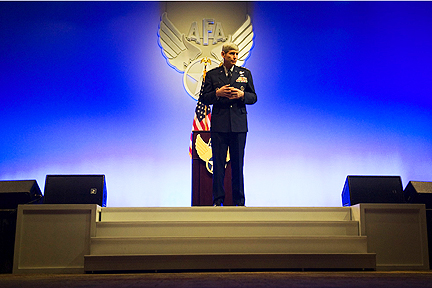
General Norton Schwartz, USAF's Chief of Staff
"Because our nation's diverse interests — diplomatically, financially, economically and militarily — exist around the globe, we have an enduring need for robust space and cyber systems and the inherently globally-oriented capabilities that they afford," he said. "From an Air Force perspective, space and cyber power enable our ability to provide global mobility, global strike, intelligence, surveillance and reconnaissance, communications, and many other critical capabilities on which the Joint team relies on us for operational effectiveness. Our substantial dependence on space and cyberspace creates vulnerabilities that are potentially exploitable by our adversaries; an outcome with profound strategic implications," he continued. "Therefore, our efforts to protect these interests in space and cyberspace must be as ambitious as our reliance on these domains. We must be able to deter and defend against attacks on our space and cyber capabilities, and fight through any degradation, disruption or even denial of these vital capabilities."
Threats to space and cyber capabilities pose some of the most significant challenges to the nation's national security, said the 1973 U.S. Air Force Academy graduate. Those who pose these threats must be deterred or, if necessary, compelled to stop. "Attacks on our space and cyber capabilities are potentially more consequential than what would occur from a purely military perspective," he said. "Because of this, we need to expand our definition of what constitutes a threat to our space and cyber capabilities. We must also consider a broader scope of adversaries," said the general who has more than 4,300 flying hours in Air Force aircraft. "The list includes not only rival nation-states, but also potentially any number of non-state, sub-national and even individual actors that can threaten the advantage we currently enjoy from space- and cyber-borne capabilities."
The general concluded his speech by calling attention to the people behind the highly-technical mission —- some 46,000 total force Airmen and contract employees "from acquisition to operations to logistics" — who are dedicated to supporting the space mission. "While space and cyberspace certainly showcase our innovation and advanced technology, let us not forget that it is our Airmen, through their daily professional efforts, who make it all happen." (Source: USAF website, Master Sgt. Ben Gonzales)