

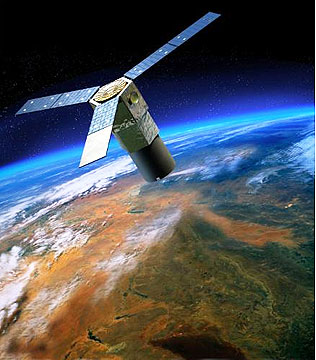
ARTEMIS, designed and built in fewer than 15 months, brings new tactical space surveillance capabilities to field commanders and is the first hyperspectral imaging sensor to serve tactical military purposes from space. (PRNewsFoto/Raytheon Company)
A groundbreaking space sensor built by Raytheon Company (NYSE: RTN) has completed its second year on orbit, exceeding its design life by 100 percent. The Advanced Responsive, Tactically Effective Military Imaging Sensor was launched aboard the Air Force Research Laboratory's TacSat-3 in May 2009. Originally slated for a one-year experimental mission, ARTEMIS performed so well that the U.S. Air Force Space Command took control of TacSat-3 for operational use in June 2010.
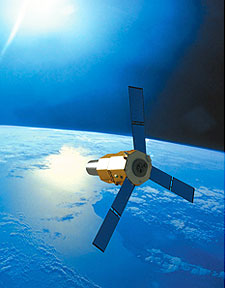
Artistic rendition of the TacSat-3 satellite
While ARTEMIS is focused on the visible and shortwave infrared bands, Raytheon is developing the next generation of hyperspectral systems, which will take advantage of the unique attributes of the bands of the infrared spectrum. Mid-wave IR hyperspectral sensors will be able to identify faint heat signatures from space, while long-wave IR sensors can be used to characterize effluents, such as factory plumes.