

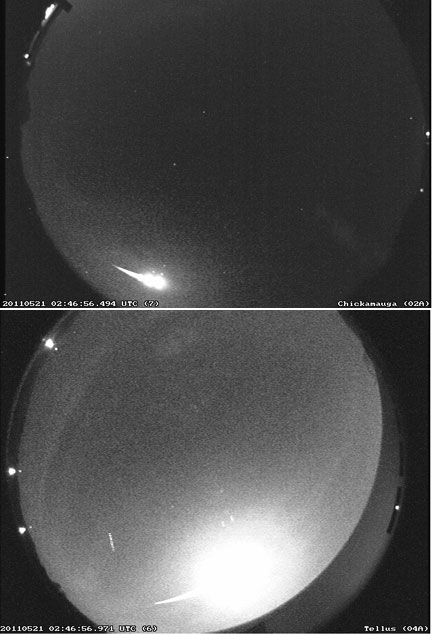
Meteor over Macon, Ga., on the evening of May 20, 2011. (NASA/MSFC/MEO)
Astronomers at NASA's Marshall Space Flight Center have recorded the brightest meteor seen by their network in almost three years of operation. On May 20, 2011, at 9:47 p.m. CDT, a six-foot diameter fragment of an unknown comet entered the atmosphere approximately 66 miles above the city of Macon, Ga., traveling northwest at a speed of some 24 miles per second (86,000 mph). At this velocity, the boulder-sized "dirty snowball" possessed an energy or striking power somewhere between 500-1000 tons of TNT. This was seen by many eyewitnesses in Georgia and Alabama; the American Meteor Society has some of the reports at the following direct link: http://www.amsmeteors.org/fireball2/public.php?start_date=2011-05-01&end_date=2011-05-31&state=&event_id=511&submit=Find+Reports
The meteor was tracked by two NASA all sky cameras, one located in Chickamauga, Ga., and the other at the Tellus Science Museum in the town of Cartersville, Ga. Analysis of the video data from these cameras enabled the Meteoroid Environment Office to estimate the trajectory, speed, mass and orbit of the meteor. Fortunately the atmosphere provided excellent protection. A NASA video, when slowed to one-third of the actual real-time speed, makes it easy to spot the large fragments coming off the meteor in the wake after the flares. The video also shows four distinct flares caused by the meteor breaking apart in its fiery final few seconds. Fragments coming off in the meteor's wake can be seen after three of these flares. After a last burst of light, the meteor ablated — or "burned up" — 38 miles above the town of Villa Rica, Ga., located on the border between Carrol and Douglas counties in Georgia.
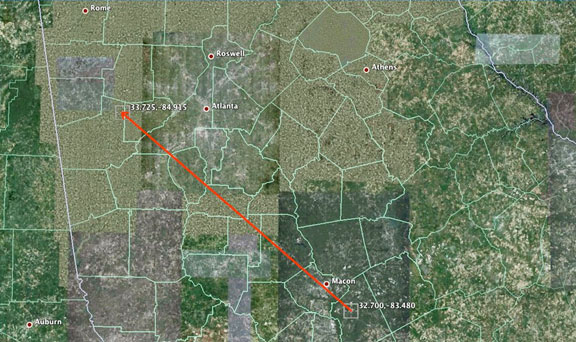
Ground track of meteor's path. (Google)