

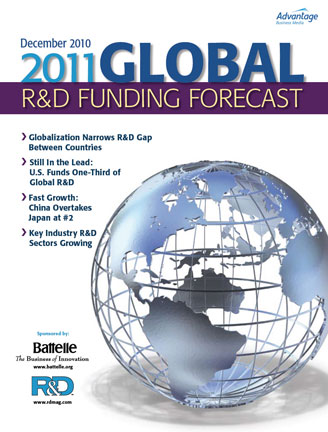
The forecast predicts United States R&D will grow by only 2.4 percent over the final 2010 estimate, reaching $405.3 billion in 2011. With the 2011 inflation rate forecasted to remain a low 1.5 percent, this growth still leads to 0.86 percent, or $3.4 billion, growth in real terms. A snapshot of the report reveals the following megatrends:
- Globalization increasingly is narrowing the R&D gap between countries
- The U.S. still leads all countries by funding one-third of global R&D
- China has overtaken Japan as the second highest funder of global R&D
"The continued expansion of R&D in China is both inspiring in magnitude and worrisome from a U.S. competitive perspective," said Marty Grueber, Battelle Research Leader and co-author of the report. "The Chinese are doing everything in their power to grow and develop through an increasing understanding and emphasis on research and technology. Even most of their highest ranking political leaders are engineers."
- Industrial Outlook: Industry R&D spending in the U.S. will reach $286.9 billion in 2011, a 3 percent increase of $8.4 billion over 2010 levels. At this level, industrial R&D activities will account for 70.8 percent of all R&D performed in the U.S.
- Federal Government Outlook: Federally performed R&D is expected to decline by slightly more than $200 million, to $27.5 billion in 2011. Part of this decrease reflects the fact that most intramural American Recovery and Reinvestment Act (ARRA) funds were spent in 2009 and 2010.
- Academia: Research by U.S. academic institutions is forecast to reach $57.5 billion in 2011, an increase of 1.9 percent over 2010.
- Global Outlook: While U.S. R&D still dominates worldwide spending, globalization is slowly altering the dominance that the U.S. has maintained for the past 40 years. The economies of China, Korea, India, Russia and Brazil and their investments in R&D are expanding at rates substantially higher than that of the U.S., Japan and Germany. As a result, emerging economies are starting to challenge the technological and discovery capabilities of the historic R&D leaders.
- Aerospace/Defense/Security: No segment has a stronger connection to public R&D investment than aerospace, defense and national security. In the past, defense budgets have been minimally affected during periods of budgetary constraints, but this is about to change. Many factors are aligning to change the level and focus of defense spending in the future, including significant budget deficits, the growing federal debt crisis and related scrutiny of discretionary spending like R&D, the sluggish economy, the changing status of the Iraq and Afghanistan wars, and the evolving nature of U.S. defense activities in general.
- Information Technologies: The software industry's spending on R&D slowed during the recent recession but is projected to see increases in 2010 and 2011. The increase is driven, in part, by the increased adoption of embedded control and interface software in a wide range of applications. Sectors increasingly relying on more software to simulate, design, operate and control products, systems and manufacturing procedures include the telecom, automotive, energy, pharmaceutical, banking and finance, and aerospace and defense industries.
- Electronics/Computers: Current hardware technology development is responding to growth in a number of areas including cloud computing, Internet servers, mobile computing, wireless, integrated power supplies, satellite-based communications, flexible circuits and displays, multiple-core processors, carbon nanotube circuits, printed circuits and more.
- Advanced Materials: Across all industries, including automotive, aerospace, oil and gas exploration and consumer packaging, there is a common need for lighter, more efficient systems that reduce energy consumption while delivering on the intended mission. Nowhere is materials research more strong in 2010 and 2011 than in nanotechnology.