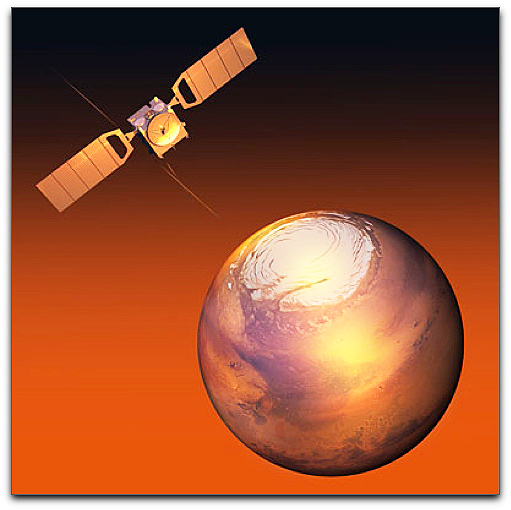
 Mars Express has begun a series of flybys of Phobos, the largest moon of Mars.
 The campaign will reach its crescendo on March 3rd, when the spacecraft will set a new record for the closest pass to
Phobos, skimming the surface at just 50 km — the data collected could help untangle the origin of this mysterious moon.
The latest
Phobos flyby campaign began at 06:52 CET (05:52 UT) on February 16th, when
Mars Express drew to within 991 km of Phobos’ airless surface. The flybys will continue at varying altitudes until March 26th when Phobos moves out of range. They offer prime chances for doing additional science with Mars Express, a spacecraft that was designed to study the red planet below rather than the grey moon alongside.

HRSC aboard Mars Express — Credits: Alex Lutkus + DLR/FU Berlin/ESA 2003
Heavy emphasis is being placed upon the closest flyby because it is an unprecedented opportunity to map Phobos’ gravity field. At that range, Mars Express should feel differences in the pull from Phobos depending which part of the moon is closest at the time. This will allow scientists to infer the moon’s internal structure. Previous Mars Express flybys have already provided the most accurate mass yet for Phobos, and the
High Resolution Stereo Camera (
HRSC) has provided the volume. When calculating the density, this gives a surprising figure because it seems that parts of Phobos may be hollow. The science team aim to verify this preliminary conclusion. In particular, the
MARSIS radar will operate in a special sequence to try to see inside the moon, looking for structures or some clue to the internal composition. The origin of Phobos is a mystery. Three scenarios are possible. The first is that the moon is a captured asteroid. The second is that it formed in situ as Mars formed below it. The third is that Phobos formed later than Mars, out of debris flung into Martian orbit when a large meteorite struck the red planet.
Topical Tags :
Regional Tags :