

 [SatNews] Orbital Sciences Corporation (NYSE: ORB) has been selected by the...
...National Aeronautics and Space Administration (NASA) to design, manufacture, integrate and test a new heliophysics science satellite that will investigate the connection between space weather storms in the ionosphere, located at the edge of outer space, and Earth’s terrestrial weather. Orbital will provide its LEOStar-2 spacecraft platform and conduct systems integration and test for the Ionospheric Connection Explorer (ICON) mission at its Dulles, Virginia, satellite design and production facilities. Orbital’s contract for the two-year mission is valued at $50 million. The mission, which will be led by the University of California at Berkeley, is currently planned for launch in 2017.
The mission of the ICON satellite is to study the interface between the upper reaches of the Earth’s atmosphere and outer space in response to a recent scientific discovery that the ionosphere, positioned at the edge of space where the Sun ionizes the air to create charged particles, is significantly influenced by storms in the lower atmosphere. ICON will also help NASA better understand how atmospheric winds control ionospheric variability.
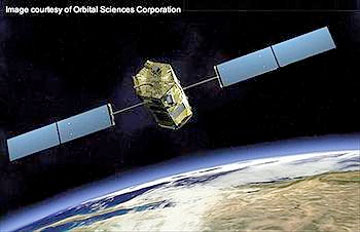
The LEOStar-2 platform.
ICON was awarded under NASA’s Explorer series of lower-cost and highly-productive space science satellites. Orbital has built multiple Explorer satellites for NASA, including the in-orbit NuSTAR, Swift, GALEX, AIM and IBEX spacecraft. In addition, Orbital was recently awarded a $75 million contract to design, build, integrate and test, as well as to perform mission operations, for another Explorer satellite, the Transiting Exoplanet Survey Satellite (TESS).
The ICON program is being led by Principal Investigator (PI) Dr. Thomas Immel of the University of California/Berkeley’s Space Sciences Laboratory (UCB/SSL) and mission management is performed by UCB/SSL under NASA’s Goddard Space Flight Center Explorers program. The PI-led ICON mission features partners from the Naval Research Laboratory and the University of Texas/Dallas. Mission Operations will be performed by the UCB/SSL Mission Operations Center, which is currently operating the Orbital-built and launched NuSTAR astrophysics Small Explorer satellite.
The current LEOStar-2 product line has demonstrated an exceptional record for reliability, with four currently in orbit, another in production, and the TESS and ICON programs to be started later this year.