

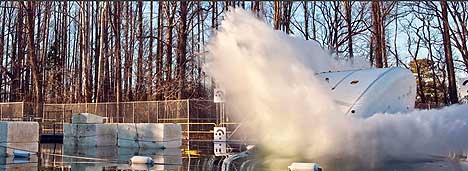
After six months of testing, an 18,000 pound (8,165 kg) Orion mockup took its final splash into NASA Langley Research Center's Hydro Impact Basin on January 6.
Final Orion drop test was completed at Langley Research Center. After six months of testing, an Orion mockup took its final splash into NASA Langley Research Center’s Hydro Impact Basin on January 6. Among its multiple functions, Orion will carry astronauts into space and ensure safe re-entry and landing.
Orion, the next deep space exploration vehicle, will carry astronauts into space, provide emergency abort capability, sustain the crew during space travel, and ensure safe re-entry and landing.
The testing, which began in July 2011, simulated different water landing scenarios and took into account different velocities, parachute deployments, entry angles, sea states and wind conditions that Orion could face when landing in the Pacific Ocean.
The January 6 test represented worst case landing for an abort scenario in rough seas. The test impact conditions simulated all parachutes being deployed with a high impact pitch of 43 degrees. The capsule traveled approximately 47 mph (75.6 kph) before splashing into the basin and rolling over into the Stable 2 position.
This type of landing scenario isn't likely to occur during actual vehicle operation, but is essential for the validation of analytical models. As was the case with Apollo, the Orion flight design will feature an onboard up-righting system.
The Orion project began a long time ago.
The following is taken from a September 29, 2006 log...NASA is marking a historic moment in the life of the nation's largest rocket engine test complex. The Stennis Space Center conducted the final space shuttle main engine test on its A-1 Test Stand on Friday, September 29. Although this ends the stand's work on the Space Shuttle Program, it will soon be used for the rocket that will carry America’s next generation human spacecraft, Orion.
The A-1 Test Stand was the site of the first test on a shuttle main engine in 1975. Stennis will continue testing shuttle main engines on its A-2 Test Stand through the end of the Space Shuttle Program in 2010.
The A-1 stand begins a new chapter in its operational history in October. It will be temporarily decommissioned to convert it for testing the J-2X engine, which will power the upper stage of NASA's new crew launch vehicle, the Ares I. The J-2X will also power the Earth departure stage of the Ares V new cargo launch vehicle. The Ares I and V vehicles will provide the thrust, while the Orion crew capsule will be future astronauts' home in space.
The J-2X is a modification of the Apollo Program's J-2 engine, which helped send the first Americans to the moon. The original J-2s were also tested at Stennis.