

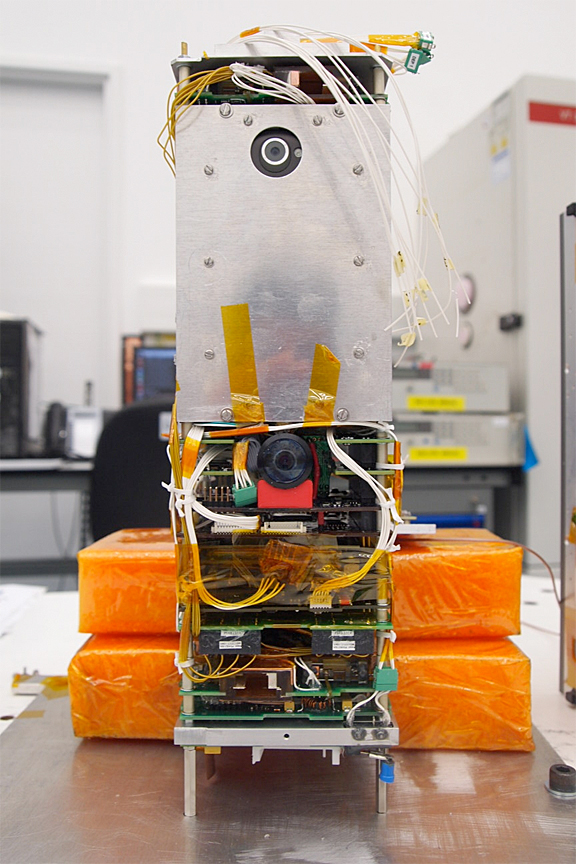
The STRaND-1 nanosatellite. The smartphone camera can be seen peeping out of the porthole at the top of the stack.
Photo courtesy of SSTL.
...the world’s first smartphone satellite into orbit, is due to launch on February 25th. The unique and innovative satellite, called STRaND-1 (the Surrey Training, Research and Nanosatellite Demonstrator), is a 30cm CubeSat weighing 4.3kg. It will launch into a 785km sun-synchronous orbit on ISRO’s Polar Satellite Launch Vehicle (PSLV) from Sriharikota, India.
STRaND-1 will also be the first U.K. CubeSat to be launched and has been developed by talented space engineers and researchers at Surrey with the majority of the design and developmental work being carried out in their spare time. The build and test phase of the project has been completed in just three months.
At the heart of STRaND-1 is a Google Nexus One smartphone with an Android operating system. Smartphones contain highly advanced technologies and incorporate several key features that are integral to a satellite—such as cameras, radio links, accelerometers and high performance computer processors—almost everything a spacecraft needs except the solar panels and propulsion. During the first phase of the mission, STRaND-1 will use a number of experimental ‘Apps’ to collect data while a new high-speed Linux-based CubeSat computer developed by SSC takes care of the satellite. During phase two, the STRaND-1 team plan to switch the satellite’s in-orbit operations to the smartphone, thereby testing the capabilities of a number of standard smartphone components for a space environment. The satellite will be commissioned and operated from the Surrey Space Centre’s ground station at the University of Surrey.
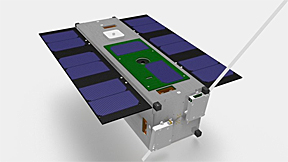
Artistic rendition of the STRaND-1 nanosatellite, courtesy of SSTL
Dr. Chris Bridges, SSC’s lead engineer on the project, said, “A smartphone on a satellite like this has never been launched before but our tests have been pretty thorough, subjecting the phone to oven and freezer temperatures, to a vacuum and blasting it with radiation. It has a good chance of working as it should, but you can never make true design evolutions or foster innovation without taking a few risks: STRaND is cool because it allows us to do just that.”
SSTL’s Head of Science, Doug Liddle, said, “We’ve deliberately asked this enthusiastic and talented young team to do something very non-standard in terms of the timescales, processes and the technologies used to put the satellite together because we want to maximise what we learn from this research programme. I can’t wait to see what happens next!”