

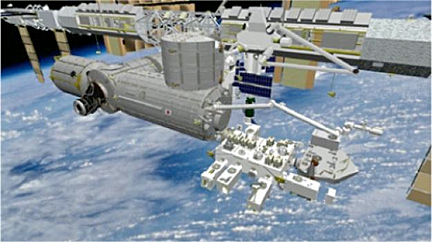
Computer model showing the Japanese Experiment Module on the International Space Station. (Credit: JAXA)
[SatNews] "Just like robotic refueling, there were a lot of folks who said that this simply couldn't be done..."
It may be called the Robotic Refueling Mission (RRM), but NASA's RRM was built to demonstrate much more than the clever ways space robots can fill up satellites. With the launch of new hardware to the International Space Station on August 3rd., RRM—recently named a "Top Exploration Technology Application From the International Space Station in 2012"—will be outfitted to practice a new set of satellite-servicing activities.
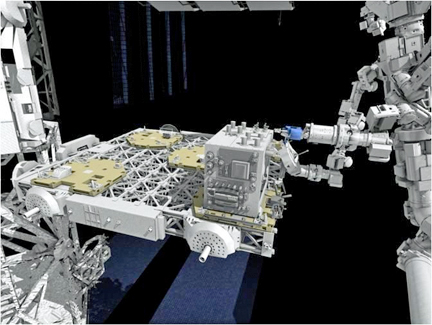
This artistic representation shows ISS's Dextre robot (right) performing a robotic refueling task on RRM (center), mounted to ELC4. Image courtesy of NASA.
"Just like robotic refueling, there were a lot of folks who said that this simply couldn't be done," says Benjamin Reed, deputy project manager of the Satellite Servicing Capabilities Office (SSCO) at NASA's Goddard Space Flight Center in Greenbelt, Maryland. "But that's the whole point of the RRM demonstrations -- and the beauty of being able to execute them on such an extraordinary test bed as the space station. RRM is allowing us to show that the robotic satellite-servicing tools, technologies and techniques are mature and ready, because we've proven them on orbit."
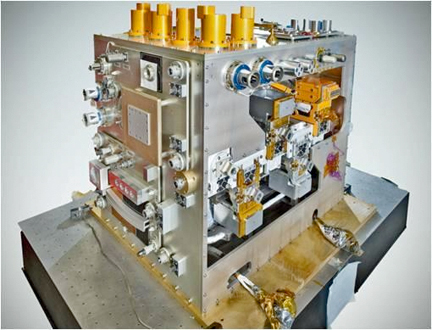
The RRM payload box is peppered with refueling components and activity boards and contains a fluid transfer system. Four unique tools are stowed within RRM until Dextre retrieves them. Photo courtesy of NASA.
A second shipment in 2014 will bring a second task board and a new device called the Visual Inspection Poseable Invertebrate Robot (VIPIR). This SSCO-built borescope inspection tool provides a set of eyes for internal satellite repair jobs. Both also will be transferred and installed on RRM via the Japanese airlock, ROTC and Dextre.
With the help of the twin-armed Dextre robot, the newly installed RRM task boards, and the RRM tools, the RRM team will then work its way through intermediate steps leading up to cryogen replenishment. After retrofitting valves with new hardware, peering into dark places with the aid of VIPIR and creating a pressure-tight seal, the RRM and Dextre duo will stop short of actual cryogen transfer for this round of tasks.
RRM Phase 2 operations are scheduled to begin in 2014. Initial activities to demonstrate this in-orbit capability—cutting wires and removing caps—were completed in 2012 with the aid of the original RRM tools and activity boards.
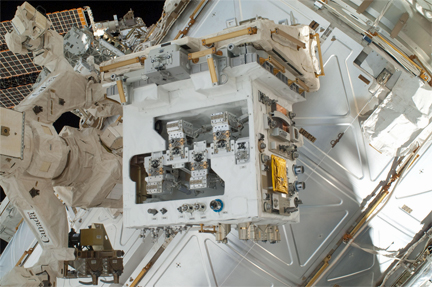
With the International Space Station's accordion solar array in the background, the Dextre "OTCM" (at end of arm) uses its built-in cameras and lights to scan the Robotic Refueling Mission module during the Vision Task. This data will help develop machine vision algorithms against the harsh lighting on orbit, aiding future autonomous robotic operations beyond RRM. Image courtesy of NASA.
"It's all about expanding options for fleet operators, in both the government and the commercial sectors," Reed said. "Instead of retiring an aging observatory or spacecraft -- and perhaps launching a new, costly, one -- [operators] could choose to extend their lives by calling on a future cryogen-toting space tow truck. The RRM demonstrations are an important step to eventually enabling this capability."
"Since its launch to the ISS in 2011 on the last shuttle mission, RRM has been steadily practicing robotic satellite-servicing activities on orbit," says Jill McGuire, RRM project manager at SSCO. "A joint effort with the Canadian Space Agency, RRM uses the space station as a test bed for technology research and development."
On July 17, RRM was named a "Top Exploration Technology Application from the International Space Station in 2012" at the second international ISS Research and Development Conference in Denver. McGuire accepted on behalf of the team. NASA developed RRM to demonstrate how remotely-operated robot mechanics could extend the lives of the hundreds of satellites residing in geosynchronous-Earth orbit (GEO). Costly assets traveling about 22,000 miles above Earth, GEO spacecraft deliver such essential services as weather reports, cell phone communications, television broadcasts, government communications and air traffic management. Servicing capabilities could greatly expand the options for government and commercial fleet operators in the future. They could potentially deliver satellite owners significant savings in spacecraft replacement and launch costs.
NASA continues to test capabilities for a new robotic servicing frontier. In conjunction with RRM, the SSCO team has been studying a conceptual servicing mission while building the necessary technologies, including an autonomous rendezvous and capture system, a propellant transfer system and specialized algorithms to orchestrate and synchronize satellite-servicing operations.
(