

The system is currently deployed on aircraft or UAVs but could be enhanced in the future to support satellite platforms. As a dual-use payload, the 'Chariot' has already been deployed in Israel and abroad on various missions, such as tracking uranium contamination from mining activity, oil spills and monitoring efficiency and spillage from water treatment facilities. ElOp is already developing a multi-spectral imaging sensor for a satellite under the French-Israeli VeNUS program. Hyperspectral data is useful in a wide variety of applications relating to the classification or identification of properties of objects with high precision and resolution. Elbit Systems' Electro-optics Elop has been assigned by the Israeli government as a national center of excellence for this field. The current technological solutions are focused on HS airborne sensors employing continuous sensing through multiple, very narrow spectral bands covering Visual, Near Infra-Red (VNIR) and Short Wave Infra-Red (SWIR) domains (0.4-2.5 micron).
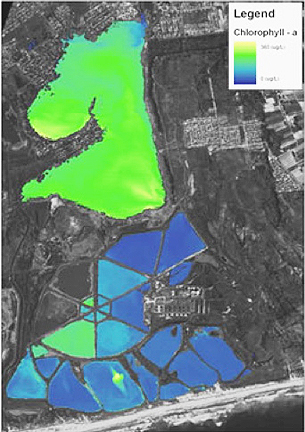 Hyperspectral sensing has many military applications in Measurement and Signature Intelligence (MASINT). Many such applications are also relevant to commercial uses, positioning these instruments as dual-use sensors. For example, environmental mapping of aquatic areas, or monitoring pollution levels (see photo above left), in the civil applications, could translate into tracing specific chemicals related to Weapons of Mass Destruction (WMD). Geologic mineral mapping could translate in the military to tracking of underground activity. Agriculture applications like precision farming, growth monitoring, yield prediction, and soil classification are paralleled in the military world as identification of weapon caches, fortification, mining, camouflage discrimination, terrain and mobility assessment, etc.
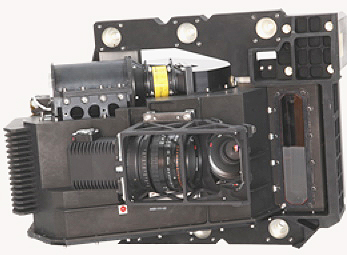
Elbit Systems' hyperspectral camera integrates multiple sensors simultaneously and gathers reflected radiation in 215 spectral bands in the 0.35 - 2.5 nm range.