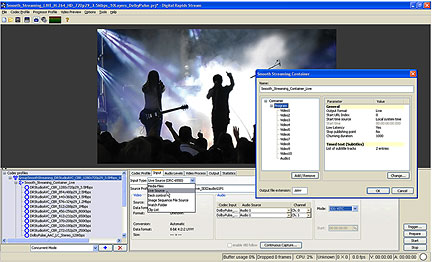

- Digital Rapids has released version 3.4 of the Digital Rapids Stream software for the company's StreamZ, StreamZHD, Flux and DRC-Stream encoding and live streaming solutions. In addition to previously announced new features —- including frame-compatible 3D support and enhanced JPEG2000, H.264 and MPEG-2 format support — the version 3.4 release also includes support for the MXF AS02 application specification, enhanced Microsoft Internet Information Services (IIS) Smooth Streaming capabilities, expanded video and audio processing plug-ins and more. Support for Microsoft PlayReady DRM technology has also been extended to enable creation of H.264 (AVC) compressed media compliant with the Protected Interoperable File Format (PIFF) specification. New extensions to the Digital Rapids Studio AVC Encoder module add support for frame-compatible stereoscopic 3D applications. Separate left-eye and right-eye source files can be combined for side-by-side or top/bottom frame-compatible distribution, with the appropriate Frame Packing Arrangement SEI messages inserted during H.264 encoding. SEI messages can also be inserted while encoding previously-combined, single-file frame-compatible 3D sources. Frame-compatible 3D delivery combines anamorphic or sub-sampled representations of the left-eye and right-eye content for compatibility with existing television distribution infrastructures and services. Plus, encoding and decoding of the JPEG2000 compression format are significantly enhanced in Stream 3.4. Support for the JPEG2000 format in the YUV color space and decoding of JPEG2000 sources with separated luminance and chrominance provide increased interoperability with third-party JPEG2000-based solutions. Version 3.4 also further enhances Digital Rapids' best-in-class MPEG-2 and H.264 encoding quality, performance and deep technical configurability. New and enhanced video and audio processing plug-ins include speed changes, 3:2 pulldown insertion, audio sample rate and bit depth conversion, Closed Caption Overlay and de-interlacing. Additional captioning-related extensions include the insertion of Closed Captions from live sources as timed text when encoding to files for viewing through Adobe(r) Flash® Player; Closed Caption retiming during frame rate conversion; and improved processing of ancillary data within broadcast server, acquisition and interchange file formats for increased workflow compatibility and caption handling. Other new features in version 3.4 include enhanced encoding for Apple® devices; a new integrated decoder for H.264 file sources; and a variety of minor additions and refinements.
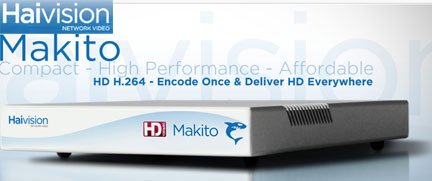
- Haivision has made significant enhancements to the Makito™ HD H.264 and Barracuda™ SD H.264 low-latency compact encoding appliances. The new real-time metadata capabilities are in response to advanced requirements from military and medical integrators that need to incorporate mission-critical data transmission within the video transport pipeline. Building on its legacy of providing the first commercial H.264 encoder to support KLV metadata encapsulation, Haivision has expanded KLV support on the Makito and Barracuda encoder families to include metadata from Ethernet (UDP/IP) and the SDI vertical ancillary data space (VANC). The ability to receive KLV metadata from UDP/IP sources enables system integrators to migrate their complete metadata architecture from serial to IP and, in turn, to realize metadata convergence and data distribution flexibility. Support of KLV metadata encapsulation from the VANC allows for direct integration of the Makito and Barracuda H.264 encoders with sensor turrets, as used in airborne vehicles, and ensures the frame accuracy of that metadata encapsulation. In fact, Haivision's VANC support was developed based on significant field testing with industry-leading sensor turrets. Haivision has also significantly expanded its support for Cursor on Target (CoT) metadata. CoT metadata was developed for airborne target acquisition and tracking, completely independently of the KLV standards developed for intelligence, surveillance, and reconnaissance (ISR) video. Haivision encoders bridge this divide by converting CoT to KLV in real time and then multiplexing the KLV metadata into MISP-compliant video streams. The single feature eliminates the need for a stand-alone mission computer to perform the same essential function, which saves significant size, weight, power, and cost. Haivision's latest firmware release supports broader CoT-to-KLV mapping libraries as used within systems by the U.S. Army, U.S. Air Force, and other Department of Defense (DoD) customers, allowing far greater interoperability across different platforms and the missions that each military branch supports. With the release of Makito and Barracuda firmware 1.5, Haivision has made both KLV and CoT metadata capabilities available as a firmware option on both products.
- Results from the newly completed IMS Research study IPTV: A Global Market Analysis – 2011 Edition indicate that the worldwide IPTV subscriber base in 2015 will exceed 70 million. Currently, the market size stands near 36.5 million. John Kendall, IMS Research Market Analyst and author of the study states, “Most of the current growth for the platform is centered in Western Europe and China. However, while China is expected to continue to experience double digit growth rates year over year, IPTV in several Western European countries is reaching the saturation point.” The emerging markets of Latin America and Eastern Europe are also expected to be IPTV hotspots. “Eastern Europe is a mixed bag,” Kendall continues. “On the one hand, you have countries like Croatia, Slovakia, and Slovenia where IPTV growth has been rapid, due to significant capital expenditure and robust network infrastructure. Russia has also experienced substantial growth for the platform on a country-wide basis. However, in Romania or Poland, there is a much more nascent IPTV market, primarily due to poor network infrastructure and highly competitive pay-TV markets.” Kendall goes on to add that he does expect the market in Eastern Europe to follow the worldwide trend and double in size by 2015. Latin America’s market emergence remains in its infancy, though there is significant growth potential in the market. “Regulator recalcitrance is the primary limitation for IPTV in Latin America,” Kendall states. “In countries like Colombia, where telcos are permitted in the pay-TV space, the platform has found a very receptive audience.” IPTV is also expected to play very prominently in the Hospitality market. STB shipments are expected to experience a 75 percent growth rate from 2010 to 2015, as hoteliers have begun to realize the flexibility and scalability of the platform. “IP delivery for VOD alone is a game-changer,” Kendall says. “Hoteliers are recognizing the value of the IP platform and are increasingly moving to adopt it.” The Fourth Edition IPTV report includes comprehensive analysis for 68 countries and profiles more than 200 operators. The report also includes a bandwidth forecast, which focuses on the amount of bandwidth utilized by IPTV households, signal delivery methods (xDSL, FTTH, & DOCSIS), set-top box shipments and revenues, and an examination of the IPTV Hospitality market. This report compliments IMS Research’s The World Market for Set-top Boxes & iDTVs, a comprehensive report on all platforms supporting DTV, which is currently in production of its 11th edition.
-
Preco reports a positive and enthusiastic reaction to the Teranex VC1-2D-3D stereoscopic image generator, which made its UK exhibition debut mid February at Broadcast Video Expo in London. Continuous demonstrations of the system were held throughout the show, led by Teranex General Manager Mike Poirier. "Every visitor who came to the stand was wowed by the effectiveness of the demonstration, which included 3D renderings of the Apollo 13 mission as well as Hollywood film footage," comments Preco's Director of Engineering and Technology, James Thomas. "Their response to the VC1-2D-3D's capabilities were very encouraging, particularly from network managers considering the introduction of 3D services or already running them. Before long, every television receiver sold will be capable of displaying 3D. The VC1-2D-3D runs on the extremely powerful Teranex VC100 processing platform, programmed to generate real-time depth information from spatial and temporal clues derived from 2D video content. This allows it to deliver credible 3D without the visual distraction seen in less advanced systems. The VC1-2D-3D is ideal for networks who want to include monoscopic source material into their stereoscopic programmes during the transition between 2D and 3D broadcasting. The system has already been chosen by ZDF in Germany for converting selected 2D content into simulated 3D." Occupying just 2 RU, the Logitek JetStream Mini incorporates eight card slots and can be configured with up to 64 audio inputs/outputs from a range of five i/o modules. Features include input metering, microphone processing, EQ, profanity delay, screen-based or optional physical operating panel, pushbutton interfaces and external device control. Logitek's Pilot manual control surface is available in multiple sizes with six, 12, 18 or 24 faders and a range of metering options. Structured for simple tabletop mounting, it incorporates 24 mix-minus buses, 12 user-configurable keys and a 16-character programmable source ident below each fader. The new Cooltouch range of rack-mounting monitors attracted the attention of many BVE attendees, offering highly space-efficient operation in mobile production vehicles, edit suites and broadcast apparatus rooms. Also shown were the new Orban OPTIMOD-FM 8600, designed to optimise FM channel sound, and the eight-channel OPTIMOD-TV 8382 television level processor which maintains a comfortable dynamic range and subjective loudness, preventing interstitials from becoming overly obtrusive.
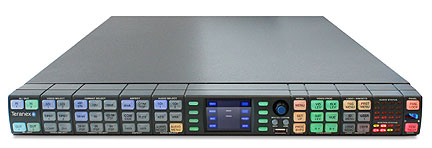
Teranex VC100 processing platform
Satnews Daily
March 7th, 2011
Of Interest To SatBroadcasting™ Professionals...