

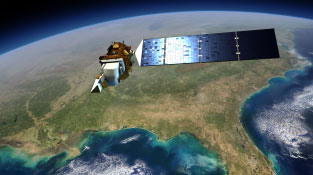
Orbital’s satellite designed, built and tested in Gilbert, Arizona will capture critical Earth Observation data for use by numerous industries. This Orbital-built spacecraft will maintain the longest continuous record of Earth’s environment from space. At a meeting in Arizona, on Thursday, December 13, 2012 from 2:30-4:00 p.m. MST, at 1721 West Elliot Rd., Gilbert, Arizona 85233, a U.S. Government official will detail the use and importance of this Landsat data.
Orbital Sciences Corporation will offer a first look at the completed Landsat Data Continuity Mission Satellite (LDCM) satellite.
Upon its launch from California in early 2013, LDCM will be known as Landsat8 and will continue the NASA and U.S. Geological Survey (USGS) Earth observations program. The newest LandSat in the fleet will extend the 40-year legacy of previous Landsat satellites that have continuously collected data and images of the Earth’s surface to benefit numerous industries, including agriculture, emergency response and disaster relief.
Highlights of the media tour will include:
- Walking tour of Orbital’s satellite manufacturing facility
- Viewing of the LDCM spacecraft
- Briefing on the technical aspects of the design, manufacturing and testing of the satellite
- Briefing on use for water availability and irrigation research
- Briefing on use and value of Landsat data in Arizona
Daren Iverson, Orbital’s LDCM Program Manager Dr. Prasad Thenkbail, a USGS science expert and Research Geographer Dr. Susan Moran of the USDA Agricultural Research Service in Tucson
This is an industrial facility. Media participants in attendance should wear closed-toe shoes for safety purposes.
The suite of Landsat satellites have collected multi-spectral land images and data of the Earth’s continental surfaces for more than 40 years. This data is collected by 17 ground stations worldwide and used to positively impact industries, including agriculture, geology, forestry, regional planning, education, mapping, global change research, emergency response and disaster relief. Orbital is building LDCM for NASA and U.S. Geological Survey, which share responsibility for the Landsat program. More information about Landsat can be found at.