

....the Industry Innovators Award by the Society of Satellite Professionals International (SSPI). The MetaCarrier technology embeds and detects Carrier ID on video and data satellite carriers, and significantly reduces the time to identify and clear satellite transponders of interference sources. The Industry Innovators Awards recognize outstanding new contributions to the field of satellite communications by both private-sector and public-sector organizations. Honorees are chosen by a committee of industry experts for accomplishments ranging across a broad spectrum of advanced satellite technology and business applications.
"Comtech EF Data received this award based on their outstanding engineering innovations," said Robert A. Bell, executive director for SSPI. "MetaCarrier is a critical component of a long-term solution to the problem of satellite radio frequency interference."
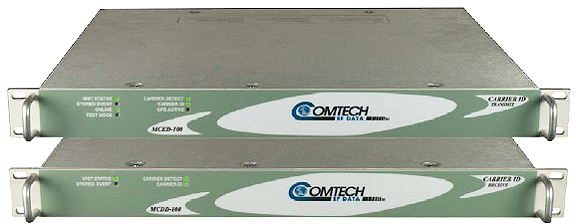
The MetaCarrier name is derived from the method of providing transmission information via metadata. This is accomplished by spread spectrum modulation of a very low data rate carrier over a portion of the referenced carrier. A large spreading factor is used that results in spreading the meta-carrier’s energy over a significantly large amount of bandwidth; many orders of magnitude of the original metadata rate. The resulting energy becomes a miniscule amount of noise being added to the referenced carrier spectrum. This also results in a coding gain that is used to extract and separate the MetaCarrier from its reference carrier. The MetaCarrier technology is currently offered by Comtech EF Data in stand-alone embedding and detecting device form factors, the MCED-100 MetaCarrier Embedding Device and the MCDD-100 MetaCarrier Detecting Device. In the future, the MetaCarrier will be offered as an integral option to Comtech EF Data modems.
"We are honored to be the recipient of this prestigious award," said Fred Morris, vice president sales engineering for Comtech EF Data. "Our technology addresses an industry-wide challenge. It will ultimately enable users to regain capacity lost to interference, reduce the personnel dedicated to interference mitigation and increase service quality."