

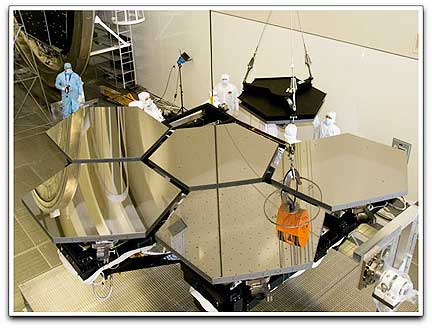
Six of the 18 James Webb Space Telescope mirror segments are being prepped to move into the X-ray and Cryogenic Facility for testing. Image Credit: NASA/MSFC/Emmett Givens
Marshall's X-ray & Cryogenic Facility is the world's largest X-ray telescope test facility and a unique, cryogenic, clean room optical test location. The test chamber takes approximately five days to cool a mirror segment to cryogenic temperatures. As this cooling takes place, engineers will measure in extreme detail how the shapes of the mirrors change, simulating how they'll react to space temperatures. Northrop Grumman Corporation is leading the design and development effort for the space agency's Goddard Space Flight Center, Greenbelt, Maryland. Mirror manufacturing began six years ago, led by Northrop Grumman's principal optical contractor Ball Aerospace. Brush Wellman in Elmore, Ohio made 21, 500-lb. hexagonal mirror blanks from beryllium, an extremely strong, lightweight metal. Axsys Technologies in Cullman, Alabama machined the backside of the beryllium blanks and chemically etched them into an isogrid pattern that reduced mirror mass by 92 percent, from 250 kg to 21 kg (equivalent to 553 pounds and 46 pounds). The front side of the mirror blank was machined to prep the optical surface for high precision grinding, polishing and testing, which is being done by Tinsley. The mirror segments have undergone a series of polishing and cryogenic testing cycles. Ball incorporates the mirrors into optical assemblies, which are mounted on the telescope structure.
The James Webb Space Telescope is the next-generation premier space observatory, exploring deep space phenomena from distant galaxies to nearby planets and stars. Webb will give scientists clues about the formation of the universe and the evolution of our own solar system, from the first light after the Big Bang to the formation of star systems capable of supporting life on planets like Earth. Expected to launch in 2014, the telescope is a joint project of NASA, the European Space Agency and the Canadian Space Agency.