

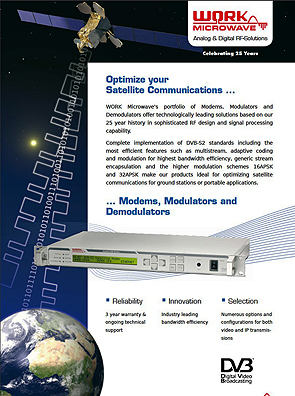
This year, WORK Microwave will introduce the new-generation DVB-S/S2 modulator with multistream technology; showcase the enhanced IP-modem, now featuring a new powerful user interface and additional power supply for BUCs; and display the company’s array of fourth-generation frequency converters. The WORK Microwave stand at IBC also demo's the company’s enhanced IP-modem, and an interactive test-bench setup will help attendees experience the ACM functionality of the IP-modem first hand.
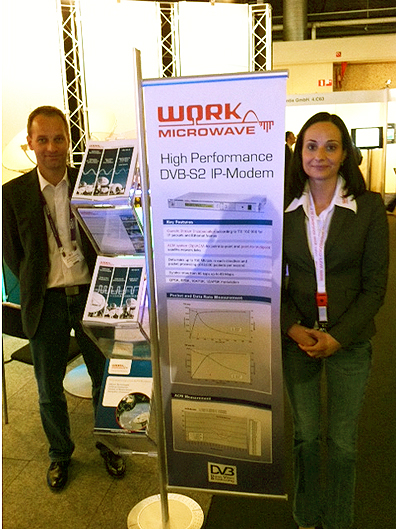
Kai Koppenburg and Lisa Hayes of WORK Microwave at IBC 2011, photo by SatNews Publishers
- Multistream Technology — Users can now aggregate up to six independent transport streams into one satellite carrier in a fully transparent manner. Multistream technology does not modify the original data streams, maintaining the integrity of the original content. Also, fewer modulation devices are required, reducing both operational expenses and capital investments for users
- Transport Stream over IP (TSoverIP) — In addition to the known ASI interface, the updated modulator now also offers transport over IP. Users can use existing network infrastructure to transport video data
- Enhanced User Interface — The powerful, easy-to-use, and intuitive user interface now supports easier access to all the new features introduced with this product update
- Data rate of up to 160Mbit/s
- Additional power supply for direct connection of BUCs to the IP-modem
- New powerful user interface
- Improved single-fan cooling system provides efficient temperature control with minimal noise
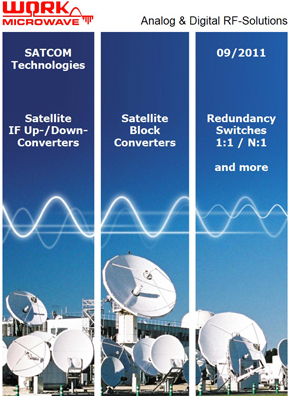
Also being showcased will be the Company's wide range of fourth-generation indoor and outdoor converters. Based on WORK Microwave’s long-term knowledge in this field, the fourth-generation (4G) converters cover the frequency bands S-, C-, X-, Ku-, K-, and Ka-, and are available as single, dual, or triple-band converters as well as dual-channel converters. All converters from WORK Microwave feature low phase noise guaranteeing excellent signal quality, while low spurious emissions enable them to be used in environments with demanding requirements such as high-power video uplinks. Additionally, they have the benefit of low power consumption due to up-to-date power supply technology and sophisticated circuit design leading to an even higher reliability and a longer life time. Users of these converters also benefit from a modular architecture that allows highly optimized designs for specific requirements (i.e., frequency range, output power, and conversion gain).