

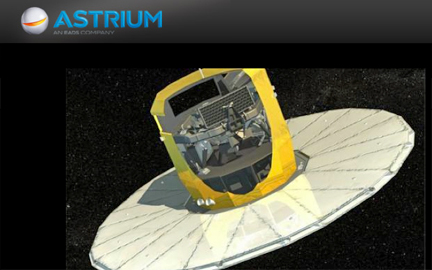
 [SatNews] Gaia, the most advanced space telescope ever built in Europe, has left the Toulouse facilities of Astrium after final integration and testing.
Gaia is now en route to its launch site in French Guiana, where it will be prepared for launch aboard Soyuz.
Designed and built by Astrium for the European Space Agency (ESA), Gaia's mission is to produce the most detailed map of our galaxy, the Milky Way, and reveal as yet unknown zones. Its goal is to enable us to understand the origins and evolution of the Universe. The Gaia Mission is also expected to discover hundreds of thousands of unknown celestial objects, including extra-solar planets and failed stars, known as brown dwarfs. Within our Solar System, Gaia will be able to identify tens of thousands of additional asteroids.
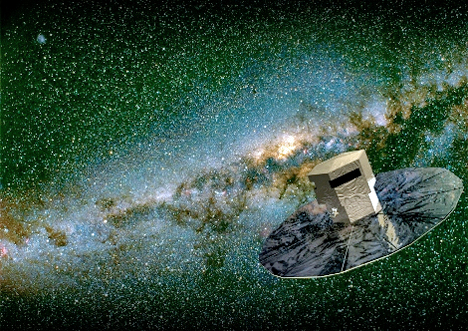
Artistic rendition of the Gaia satellite,
courtesy of the UK Space Agency.
Gaia will also use a ‘photographic’ sensor of unprecedented accuracy. The precision of Gaia measurements will be extremely high: from the Moon, it would be able to measure the thumbnail of a person standing on Earth. It has a huge focal plane made up of 106 CCD detectors gathering 1 billion pixels. For its attitude control, the spacecraft will also utilise cold gas propulsion (nitrogen), which will allow it to continuously adjust pointing performance with the required extreme accuracy.
Gaia will be located at one of the five Lagrangian points in the Sun-Earth system, at the L2 point. Lagrangian points are very precise points in the Cosmos where a body such as a satellite remains fixed and perfectly stable in space. Located 1.5 million kilometres from Earth, these locations are vital for astronomy observation missions which require high pointing stability.