

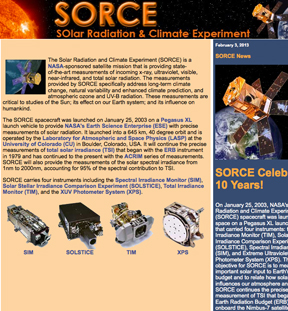
 [SatNews] Orbital Sciences Corporation (NYSE: ORB) is celebrating the tenth anniversary of the launch and successful operation of...
...the company-built Solar and Radiation Climate Experiment (SORCE) satellite. Ten years ago, SORCE was launched into orbit aboard Orbital’s Pegasus rocket in a mission that originated from Cape Canaveral, Florida. The original plan for the SORCE mission was to provide continuous solar climate science and Earth atmospheric data for five years. Ten years later, the program’s Mission Operations Center at the University of Colorado’s Laboratory for Atmospheric and Space Physics (LASP) is still receiving valuable data that is shared with the science community worldwide.
Scientists who study the Sun and Earth’s environment use SORCE data in conjunction with other measurements to track and analyze the connection between solar changes and atmospheric or climate changes on Earth. The SORCE science mission and the instruments aboard the spacecraft were conceived, designed and built by LASP. The project’s funding and oversight is provided by NASA’s Goddard Space Flight Center.
The SORCE spacecraft is based on Orbital’s LEOStar satellite platform. It was selected by LASP to host the sensitive instruments that record the Sun’s energy and measure all wavelength spectrums. The satellite also carries other instruments that record the level of radiation entering and leaving Earth’s atmosphere. This type of data is valuable to the heliophysics and atmospheric science communities to better understand how solar events affect climate change on Earth.
The SORCE satellite will soon be joined by other Orbital-built LEOStar spacecraft like LDCM (Landsat-8), which will be launched in several weeks, and ICESat-2, which is now in production, in providing long-term continuous data records to help us better understand Earth’s environment. In addition, Orbital’s satellite platforms are also well suited for future government weather missions such as the Joint Polar Satellite System-2 (JPSS-2), the JPSS Free Flyer-1 and the U.S. Air Force’s Weathersat Follow-on.