

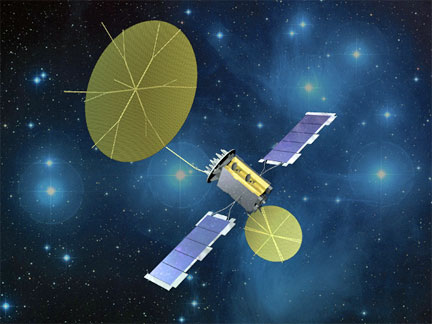
Artistic rendition of the MUOS satellite series, courtesy of Lockheed Martin.
That’s due to the fact that older communication systems needed terminals that were stationary and in the open—not ideal for missions when mobility is key and time is of the essence. The Mobile User Objective System, a Lockheed Martin satellite communications network for the U.S. Navy, is changing that concept—the MUOS system accomplished its first secure data and voice call using an on-orbit satellite and associated ground stations.
Recently, two General Dynamics AN/PRC-155 Manpack radios successfully completed a secure radio-to-radio voice and data “call” through the MUOS satellite network, as part of a scheduled MUOS end-to-end system demonstration. The PRC-155 radio is part of the Handheld, Manpack, Small Form Fit family of radios.
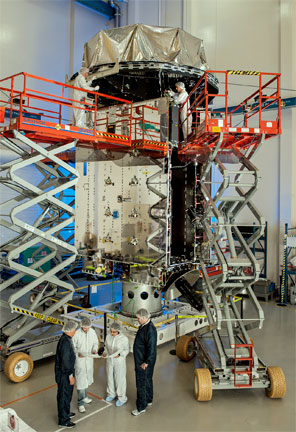
Lockheed Martin’s fourth MUOS spacecraft completes its multi-beam assembly mate process. Crowning the satellite, the circular platform contains 16 ultra-high frequency antennas for wide-ranging coverage. With its major components now integrated, the spacecraft can enter system and environmental test.
Photo courtesy of Lockheed Martin.
During the demonstration, one radio successfully transmitted voice and data communications through the orbiting MUOS satellite, to the MUOS ground station, back through the satellite and to a second radio.
MUOS satellites are equipped with two payloads: the Wideband Code Division Multiple Access (WCDMA) payload that provides a 16-fold increase in transmission throughput over the current Ultra High Frequency satellite system, and a legacy payload that works seamlessly with currently-fielded terminals. Earlier this year, Lockheed Martin delivered the completed waveform, developed by General Dynamics, to the U.S. Navy. The waveform, now published in the government’s library, allows radio developers to integrate the software into existing radios so they can realize the benefits of the MUOS network.
The second MUOS satellite will ship next month to Cape Canaveral Air Force Station, Florida, for launch in July. After certification of the ground and terminals for use, the WCDMA payloads on both MUOS satellites will be usable by warfighters in the field.