

[SatNews] Due to resource constraints caused by sequestration, Air Force Space Command has directed the 21st Space Wing to prepare to discontinue operations at the Air Force Space Surveillance System by October 1st.
Final decisions on all Fiscal Year 2014 budget issues will be made over the next few weeks. By discontinuing operations, the AFSSS would not be maintained in operational status; however, equipment will not be removed until a final disposition determination is made. The AFSSS sites are operated under contract and the 21st SW has notified the vendor, Five Rivers Services in Colorado Springs, Colorado, that it most likely will not exercise the next contract option beginning Oct. 1.
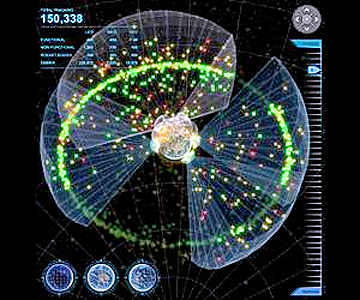
The existing Air Force Space Surveillance System, or VHF Fence, has been operational since the early 1960s, and will be replaced by the Space Fence, illustrated here. Image courtesy of Lockheed Martin.
The AFSSS is a series of three transmitters and six receivers along the 33rd parallel stretching across the southern United States. The three transmitter sites are located at Jordan Lake, Alabama; Lake Kickapoo, Texas; and Gila River, Arizona. The six receivers are located at Tattnall, Georgia.; Hawkinsville, Georgia; Silver Lake, Mississippi.; Red River, Arkansas; Elephant Butte, New Mexico.; and San Diego, California.
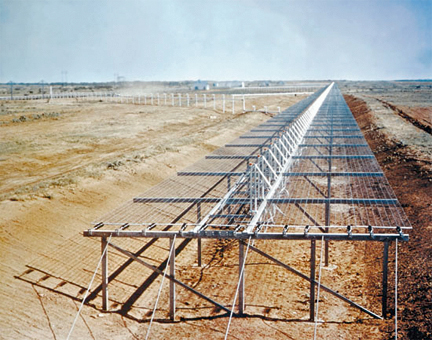
The AFSSS transmitter located at ake Kickapoo, Texas, photographed in 2001.
The AFSSS is typically referred to as the "Space Fence," which has caused confusion with the new Space Fence being developed for the future. "The AFSSS is much less capable than the Space Fence radar planned for Kwajalein Island in the Republic of the Marshall Islands," said General William L. Shelton, Commander, Air Force Space Command. "In fact, it's apples and oranges in trying to compare the two systems."
Unlike the AFSSS, the new Space Fence will provide very precise positional data on orbiting objects and will be the most accurate radar in the Space Surveillance Network. It will provide enhanced space surveillance capabilities to detect and track orbiting objects such as commercial and military satellites, depleted space boosters and space debris.
The new Space Fence will have much greater sensitivity, allowing it to detect, track and measure an object the size of a softball orbiting more than 1,200 miles in space. Because it is also an un-cued tracking system, it will provide evidence of satellite break-ups, collisions, or unexpected maneuvers of satellites.
"When combined with the new Joint Space Operations Center's high performance computing environment, the new Fence will truly represent a quantum leap forward in space situational awareness for the Nation," General Shelton said.