

Launched on August 12, 2003, SCISAT is helping a team of Canadian and international scientists improve their understanding of the depletion and recovery of the ozone layer, with a special emphasis on the changes occurring over Canada and in the Arctic.
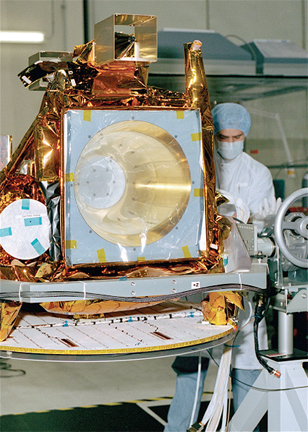
Canada's SCISAT satellite.
Photo courtesy of the CSA.
Walter Natynczyk, President of the Canadian Space Agency, said, “Earth Observation missions are an essential part of the Canadian Space Program. SCISAT represents a highly successful science mission that enabled Canadian industry to develop and demonstrate instruments and spacecraft expertise. At the same time it has enabled academia and government departments to develop cutting-edge scientific use of satellite data for atmospheric science. Originally planned as a two-year mission, SCISAT’s instruments continue to provide information about more than 30 different molecular species, which is more than have ever been thoroughly measured from space. SCISAT delivers excellent data related not only to ozone depletion, but also to climate change, air quality and pollution. Undoubtedly, SCISAT’s mission is a great Canadian success story.”
Canadian Space Agency partners in the SCISAT mission are the University of Waterloo, the University of Toronto, Environment Canada, Bristol Aerospace, ABB Analytical and COM DEV International Ltd. SCISAT effectively showcases Canada's advanced industry and leading-edge expertise in the areas of optics and spectrometry, space systems hardware and components, and small satellite bus design.